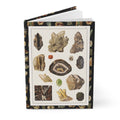
The Crystal and the Classroom: Feliks Wermiński and the Art of Polish Natural History Illustration, 1893
A mineral crystal is one of the most geometrically perfect objects in nature. Formed over millions of years by the slow accretion of atoms into regular lattice structures, it embodies a kind of mathematical order that seems almost impossible in a world of organic irregularity. The great mineralogists of the nineteenth century — men like James Dwight Dana in America and Friedrich Mohs in Germany — devoted their careers to classifying and describing these structures, to finding the underlying order in the bewildering variety of forms that minerals could take. And the scientific illustrators who worked alongside them faced a particular challenge: how to represent, on a flat page, the three-dimensional geometry of a crystal, the play of light on its faces, the subtle gradations of color that distinguished one specimen from another.
Feliks Wermiński met this challenge with exceptional skill. His mineral plates from Historya naturalna w obrazach — Natural History in Pictures — published in Warsaw in 1893, are among the finest examples of mineralogical illustration produced in nineteenth-century Poland. Plates 22 and 23, which appear on the covers of our journal, show mineral specimens of extraordinary variety and beauty: crystals and aggregates, massive and fibrous forms, specimens that range from the translucent clarity of quartz to the deep metallic lustre of galena, each one rendered with the precision of a scientific document and the sensitivity of an artist.
Feliks Wermiński and Polish Natural History in the 1890s
Feliks Wermiński was born in 1860, in a Poland that did not officially exist. The partitions of the late eighteenth century had divided the Polish lands between Russia, Prussia, and Austria, and the Polish state would not be restored until 1918. In the Russian-controlled territories where Wermiński worked, Polish cultural and educational life was conducted under conditions of political suppression: the Russian authorities periodically banned the use of the Polish language in schools, and Polish intellectuals and educators faced constant pressure to conform to Russian cultural norms.
In this context, the production of Polish-language educational materials was not merely a pedagogical act but a cultural and political one. To publish a natural history textbook in Polish, illustrated with plates of exceptional quality, was to assert the vitality of Polish intellectual life and the legitimacy of Polish education. Wermiński’s Historya naturalna w obrazach was part of a broader effort by Polish educators and publishers to maintain and develop Polish-language education in the face of political adversity — an effort that would bear fruit in the restored Polish state of the twentieth century.
Wermiński himself was a naturalist of considerable range. His Historya naturalna w obrazach covered the full spectrum of natural history — minerals and rocks, plants and animals, fossils and geological formations — in a series of numbered plates designed to be used as teaching aids in Polish schools. The mineral plates — among which Plates 22 and 23 are particularly fine — reflect his deep knowledge of mineralogy and his exceptional skill as a scientific illustrator.
The Mineral Plates: A Taxonomy of Beauty
The mineral specimens shown in Plates 22 and 23 represent the full range of mineralogical variety that a nineteenth-century natural history education would have covered. Minerals are classified by their chemical composition and crystal structure, and the plates reflect this classification: specimens are grouped by type, with each group showing the characteristic forms and colors that distinguish it from others.
The challenge of illustrating minerals is, in some ways, more demanding than that of illustrating plants or animals. A plant or animal has a characteristic form that can be rendered in outline and then colored; a mineral specimen has a form that is inseparable from its optical properties — the way it reflects and refracts light, the way its color changes with the angle of illumination, the way its surface texture varies from face to face. To represent these properties convincingly on a flat page requires not just skill in drawing but a deep understanding of the optical behavior of different mineral types.
Wermiński’s plates demonstrate this understanding throughout. The translucent minerals — quartz, calcite, fluorite — are shown with the subtle internal luminosity that distinguishes them from opaque specimens; the metallic minerals — galena, pyrite, chalcopyrite — are rendered with the high reflectivity and characteristic color that makes them immediately recognisable; the fibrous minerals — asbestos, selenite — are shown with the silky sheen that results from their parallel crystal structure. Each specimen is, in effect, a small study in the optics of mineralogy — a demonstration of how light interacts with matter in ways that are both scientifically informative and visually beautiful.
The Tradition of Natural History Illustration in Nineteenth-Century Europe
Wermiński’s mineral plates belong to a long and distinguished tradition of natural history illustration that had developed in Europe over the preceding two centuries. The tradition had its roots in the great natural history publications of the seventeenth and eighteenth centuries — works like Maria Sibylla Merian’s Metamorphosis Insectorum Surinamensium (1705) and Georg Ehret’s botanical illustrations for Linnaeus — in which scientific accuracy and artistic beauty were understood as complementary rather than competing values.
By the nineteenth century, the tradition had been enriched by the development of new printing technologies — particularly lithography and chromolithography — that made it possible to reproduce natural history illustrations with unprecedented fidelity and at relatively low cost. The great natural history publications of the Victorian era — the illustrated volumes of the Geological Survey, the plates of the Challenger expedition, the chromolithographic illustrations of popular natural history magazines — brought the beauty of the natural world to a mass audience for the first time.
Wermiński’s Historya naturalna w obrazach was part of this broader democratisation of natural history illustration. Designed for use in schools rather than for the libraries of wealthy collectors, it brought the quality of scientific illustration that had previously been available only in expensive specialist publications within reach of ordinary Polish schoolchildren. It was, in this sense, a genuinely democratic work — an attempt to make the beauty and complexity of the natural world accessible to everyone.
Mineralogy and the Nineteenth-Century Scientific Imagination
The minerals that Wermiński illustrated were not merely objects of scientific interest in the 1890s. They were also objects of cultural fascination — symbols of the hidden order of the natural world, of the mathematical beauty that lay beneath the surface of things. The nineteenth century was the great age of mineralogy: the period in which the science of crystallography was established on a rigorous mathematical basis, in which the relationship between crystal structure and chemical composition was worked out in detail, in which the classification of minerals was systematised in ways that are still used today.
This scientific progress was accompanied by a broader cultural interest in minerals and crystals that went beyond the purely scientific. The Victorian and Edwardian periods saw a fashion for mineral collecting among the educated middle classes — a fashion that was fed by the availability of illustrated guides like Wermiński’s plates, which made it possible for the amateur collector to identify and appreciate the specimens they found. The mineral cabinet — a collection of carefully labelled specimens displayed in a wooden case — was a standard feature of the educated Victorian household, a demonstration of scientific knowledge and aesthetic sensibility combined.
Wermiński’s plates served this culture of mineral appreciation as well as the more formal demands of school education. They are images that reward the kind of sustained, attentive looking that the mineral collector brings to a new specimen — images that reveal more the longer you study them, that repay close attention with an ever-deeper appreciation of the variety and beauty of the mineral world.
A Journal for Those Who Look Closely at the World

Our Feliks Wermiński Mineral Specimens Journal carries Plates 22 and 23 from Historya naturalna w obrazach across its full wraparound cover — the mineral specimens rendered in their original colors, the crystals and aggregates shown with the precision that Wermiński’s plates demanded. It is a journal for those who find beauty in scientific illustration, who understand that a mineral plate is also a kind of portrait of the hidden geometry of the Earth, who appreciate the Polish tradition of natural history education that produced these images.
Inside, 150 perforated lined pages await your geology notes, mineral observations, field sketches, or whatever form your engagement with the natural world takes. The casewrap sewn binding opens completely flat — ideal for field use. The matte laminated cover preserves every detail of Wermiński’s illustrations in a finish that rewards close examination.
In 1893, Feliks Wermiński drew minerals so that Polish schoolchildren could understand them. Perhaps the pages inside will help you see the world a little more clearly too.
References & Further Reading
- Burke, John G. Origins of the Science of Crystals. University of California Press, 1966. [On the development of crystallography as a scientific discipline.]
- Dana, James Dwight. System of Mineralogy. 6th ed., Wiley, 1892. [The standard mineralogical reference of the period, contemporary with Wermiński’s plates.]
- Jardine, N., Secord, J.A. & Spary, E.C. (eds.). Cultures of Natural History. Cambridge University Press, 1996. [On the cultural history of natural history as a discipline.]
- Merian, Maria Sibylla. Metamorphosis Insectorum Surinamensium. Amsterdam, 1705. [Foundational work in the tradition of natural history illustration.]
- Rudwick, Martin J.S. Scenes from Deep Time: Early Pictorial Representations of the Prehistoric World. University of Chicago Press, 1992. [On the visual culture of nineteenth-century natural history.]
- Sowerby, James. British Mineralogy. London, 1802–1817. [Classic example of the mineralogical illustration tradition that Wermiński inherited.]
- Wermiński, Feliks. Historya naturalna w obrazach. Warsaw, 1893. [Primary source; digitized editions available via Polish digital library collections.]