F.B. Mills and the Art of the American Seed Catalogue
In the spring of 1904, farmers across the northeastern United States opened their mailboxes to find a catalogue from F.B. Mills of Rose Hill, New York. It was, on the surface, a commercial document — a list of seeds, poultry, and farm supplies available by mail order, with prices and ordering instructions. But it was also something else: a work of popular art, printed in chromolithography, that gave the Buff Orpington and the Barred Plymouth Rock, the White Leghorn and the Silver Spangled Hamburg, the kind of vibrant, carefully observed portraits that natural history illustrators reserved for exotic birds in expensive scientific volumes. The farmers who received it, many of them working long hours in difficult conditions, held in their hands something genuinely beautiful.
The Golden Age of the American Seed Catalogue
The mail-order seed catalogue was one of the defining commercial and cultural forms of late nineteenth and early twentieth century America. It emerged from the same conditions that produced the department store and the railway network: a vast, dispersed rural population with limited access to urban markets, connected by an expanding postal system that made it possible to order goods from hundreds of miles away and receive them within days.
The first seed catalogues were modest affairs — printed lists of available varieties, with minimal illustration. But as chromolithographic printing technology improved through the 1870s and 1880s, the catalogues became increasingly elaborate. Companies competed not just on price and variety but on the quality of their illustrations, which served both as advertising and as a kind of aspirational imagery for farmers who wanted to know what the best specimens of a given breed or variety actually looked like. By the 1890s, the leading seed and poultry catalogues were among the most visually sophisticated printed materials in circulation in rural America.
The chromolithographic process — which involved printing multiple layers of colour from separate lithographic stones, each carrying a different hue — allowed printers to achieve a richness and depth of colour that earlier printing methods could not match. In skilled hands, it could produce images of remarkable beauty: the warm golden plumage of a Buff Orpington, the precise black-and-white barring of a Plymouth Rock, the glossy black feathers and large white ear lobes of a Black Minorca. These were not photographs. They were interpretations — idealized portraits of the breeds at their finest, rendered by artists who understood both the technical demands of chromolithography and the visual language of natural history illustration.
F.B. Mills of Rose Hill, New York
Francis B. Mills operated his poultry farm and seed business from Rose Hill, a small community in Ontario County in the Finger Lakes region of upstate New York — an area with a long tradition of agricultural enterprise, well-watered and fertile, connected by rail to the markets of Rochester and beyond. Mills was one of dozens of mail-order poultry operations that flourished in the northeastern United States in the late nineteenth and early twentieth centuries, supplying eggs, chicks, and breeding stock to farmers across the country.
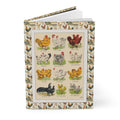
What distinguished Mills's 1904 catalogue was the quality of its chromolithographic illustrations. The twelve heritage breeds depicted on the catalogue's cover page — Buff Orpingtons, Barred Plymouth Rocks, Rhode Island Reds, Wyandottes, Light Brahmas, Sebright Bantams, and others — are rendered with a precision and vibrancy that goes well beyond the requirements of a commercial catalogue. Each bird is shown in profile, in its characteristic posture, with the distinctive features of the breed — comb shape, feather pattern, leg colour, body conformation — clearly delineated. The backgrounds are simple, allowing the birds to occupy the full attention of the viewer. The overall effect is closer to a plate from a natural history monograph than to a typical commercial advertisement.
The back page of the catalogue carried the F.B. Mills Poultry Farm advertisement, featuring four additional breeds — White Leghorns, Blue Andalusians, Silver Spangled Hamburgs, and Black Minorcas — alongside a bird's-eye view of the Mills farm facilities at Rose Hill. This combination of breed portraits and farm imagery was characteristic of the better poultry catalogues of the period: it offered the farmer both the visual information needed to identify and evaluate the breeds on offer, and a reassuring image of the operation from which they would be ordering.
The Heritage Breeds
The breeds depicted in the Mills catalogue were, in 1904, the workhorses of the American poultry industry — the breeds that had been developed, selected, and refined over decades to meet the specific demands of American farming conditions. Many of them had been created in America, or substantially developed there, from imported European stock.
The Buff Orpington had been developed in England in the 1880s by William Cook of Orpington, Kent, and had quickly become one of the most popular dual-purpose breeds on both sides of the Atlantic — valued for both its meat and its egg production, and admired for its calm temperament and its warm golden plumage. The Barred Plymouth Rock, developed in New England in the 1860s, was one of the first distinctly American breeds, combining the hardiness needed for northeastern winters with reliable egg production and good table qualities. The Rhode Island Red, developed in the 1880s in the state whose name it bears, would go on to become one of the most widely kept breeds in the world.
The White Leghorn, originally from the port city of Livorno in Tuscany — Leghorn being the English name for Livorno — had been imported to America in the 1850s and had become the dominant commercial egg-laying breed by the early twentieth century, valued for its high production, its early maturity, and its ability to thrive in a range of conditions. The Silver Spangled Hamburg, one of the oldest European breeds, was prized for its striking spotted plumage and its egg-laying ability. The Blue Andalusian, from the Spanish region whose name it bears, was a Mediterranean breed known for its elegant blue-grey lacing and its active, alert temperament.
These breeds are still kept today, by smallholders, homesteaders, and heritage breed enthusiasts who value their genetic diversity, their adaptability, and their connection to the agricultural traditions of the nineteenth century. Several of them are listed as threatened or watch breeds by the Livestock Conservancy, which works to preserve the genetic heritage of rare and endangered farm animal breeds.
The Catalogue as Document
The F.B. Mills 1904 catalogue is, among other things, a document of a particular moment in American agricultural history — a moment before the industrialisation of poultry farming, before the consolidation of the seed industry, before the replacement of the small family farm by large-scale commercial operations. The farmers who ordered from Mills were, for the most part, operating mixed farms of modest size, keeping a flock of chickens alongside other livestock and crops, selling eggs and poultry locally or through small regional markets.
The catalogue addressed them as knowledgeable participants in a shared agricultural culture — people who knew the difference between a Wyandotte and a Plymouth Rock, who understood the significance of comb type for cold-weather hardiness, who had opinions about the relative merits of the Buff Orpington and the Rhode Island Red for their particular conditions. It assumed a level of agricultural literacy that has largely disappeared from mainstream culture, though it persists in the communities of smallholders and heritage breed enthusiasts who continue to keep these birds today.
To look at the Mills catalogue now is to encounter that world at a distance — to see the breeds as Mills's artist saw them, in their idealized perfection, and to understand something of the pride and care that went into their development and their keeping. The chromolithographs are beautiful objects in their own right. They are also windows into a way of life.

Our Poultry Breeds Journal reproduces F.B. Mills's 1904 chromolithographs across its covers — twelve heritage breeds on the front, the F.B. Mills Poultry Farm advertisement on the back.
References
Fussell, G. E. (1966). The English Rural Labourer. Batchworth Press.
Kloppenburg, J. R. (1988). First the Seed: The Political Economy of Plant Biotechnology. Cambridge University Press.
Livestock Conservancy. (2023). Conservation Priority List. livestockconservancy.org.
Sanderson, M. W. (2014). Heritage Poultry Breeds of North America. Storey Publishing.
Williamson, D. (2007). Storey's Guide to Raising Chickens. Storey Publishing.