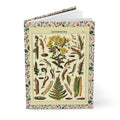
Before the Wing: Ernst Hofmann and the Chromolithographic Caterpillars of 1893
The butterfly gets all the attention. It is the butterfly that appears on the covers of books about transformation, the butterfly whose image decorates the walls of children’s rooms, the butterfly whose Latin names are learned by collectors and whose wings are pinned in museum cases around the world. But the caterpillar — the larva, the creature that the butterfly was before it became itself — is in many ways the more interesting animal. It is the caterpillar that does the eating, the growing, the accumulating of energy that will eventually power the extraordinary process of metamorphosis. It is the caterpillar that is specific to its host plant, that has evolved its colours and patterns in response to the particular pressures of its particular environment, that carries within its soft body the genetic instructions for the transformation that will produce the adult insect. And it is the caterpillar that Ernst Hofmann documented, in 1893, with a chromolithographic precision and beauty that had never been achieved before.
Hofmann’s Die Raupen der Schmetterlinge Europas — The Caterpillars of European Butterflies and Moths — was the culmination of a tradition of entomological illustration that had developed over the course of the nineteenth century, as the compound microscope and the chromolithographic press had made it possible to document the natural world with a precision and a colour fidelity that earlier illustration techniques could not achieve. Its plates show the larvae of European lepidoptera — butterflies and moths — in their natural habitats, on their host plants, in the characteristic postures and colour patterns that distinguish each species. They are images of extraordinary scientific value and considerable visual beauty: images that reward sustained attention, that reveal more the longer you look at them, that carry within them the luminous quality of the finest Victorian natural history illustration.
Ernst Hofmann and German Entomology
Ernst Hofmann worked in the tradition of German entomology that had developed, over the course of the nineteenth century, into one of the most rigorous and productive scientific traditions in Europe. German natural history in the nineteenth century was characterised by a commitment to systematic documentation — to the comprehensive cataloguing of species, the precise description of their morphology and behaviour, and the production of illustrated atlases that could serve as reference works for a generation of scientists and collectors.
This tradition had produced, by the time Hofmann published his caterpillar atlas, a remarkable body of entomological literature. The great German lepidopterists of the early and middle nineteenth century — among them Jakob Hübner, whose Sammlung europäischer Schmetterlinge had established the standard for European butterfly illustration, and Philipp Christoph Zeller, whose work on microlepidoptera had transformed the taxonomy of the smaller moths — had created a framework of systematic knowledge within which Hofmann’s atlas could take its place.
What distinguished Hofmann’s contribution was its focus on the larval stage — the caterpillar — rather than the adult insect. Earlier entomological atlases had concentrated on the adult butterfly or moth, whose wings provided the most distinctive and easily illustrated characters for identification. The caterpillar had been documented, but rarely with the systematic thoroughness and illustrative quality that Hofmann brought to it. His atlas filled a genuine gap in the entomological literature, providing for the first time a comprehensive visual reference for the identification of European lepidoptera larvae.
The Science of Metamorphosis
The process of metamorphosis — the transformation of a caterpillar into a butterfly or moth — is one of the most extraordinary phenomena in the natural world, and one that has fascinated naturalists since antiquity. The ancient Greeks knew that butterflies emerged from chrysalises, but the mechanism of the transformation remained mysterious until the seventeenth century, when the Dutch naturalist Jan Swammerdam demonstrated, through careful dissection, that the adult insect was already present, in miniature, within the body of the larva.
By the time Hofmann published his atlas, the science of metamorphosis had advanced considerably. The cellular mechanisms of the transformation — the dissolution of the larval tissues and their reorganisation into the adult body plan — were beginning to be understood through the new techniques of histology and cell biology. But the ecological dimensions of the larval stage — the relationship between the caterpillar and its host plant, the role of larval coloration in predator avoidance, the timing of the larval period in relation to the seasonal availability of food — remained areas of active research, and Hofmann’s documentation of the larvae in their natural habitats, on their host plants, contributed directly to this research.
The relationship between caterpillar and host plant is one of the most intricate in the natural world. Most lepidoptera larvae are highly specific in their food plant requirements — a given species of caterpillar will feed on only one or a few species of plant, and the distribution of the butterfly or moth is therefore determined, in large part, by the distribution of its host plant. Hofmann’s plates document this relationship with care: the caterpillars are shown on their host plants, in the characteristic postures they adopt when feeding or resting, allowing the reader to understand not just what the larva looks like but how it lives.
Chromolithography and the Victorian Natural History Plate
The chromolithographic technique that Hofmann used for his atlas was, by 1893, at the height of its development as a medium for natural history illustration. Chromolithography — printing in multiple colours from a series of lithographic stones — had been developed in the 1830s and had become, by the second half of the nineteenth century, the dominant technique for the reproduction of colour images in scientific publications. Its ability to render the subtle gradations of colour in a caterpillar’s body — the precise pattern of stripes and spots, the iridescent sheen of certain species, the texture of the skin — made it ideally suited to entomological illustration.
The production of a chromolithographic plate of the quality achieved in Hofmann’s atlas required the collaboration of several specialists: the entomologist who provided the specimens and the scientific knowledge, the artist who made the original drawings, and the lithographic printer who transferred the drawings to stone and produced the final printed image. Each colour in the final image required a separate stone, and a complex plate might require ten or more printings to achieve the full range of colours. The result, at its best, was an image of extraordinary fidelity — one that could render the precise pattern of a caterpillar’s markings with a accuracy that no earlier printing technique could match.
Larval Coloration: Camouflage, Warning, and Mimicry
One of the most striking features of Hofmann’s plates is the extraordinary diversity of colour and pattern among the caterpillars he documented. Some are cryptically coloured — green or brown, matching the colour of their host plant so closely that they are virtually invisible to a predator searching the foliage. Others are boldly patterned — striped or spotted in contrasting colours that advertise their unpalatability to potential predators. Still others mimic the appearance of other objects in their environment — twigs, bird droppings, or other insects — in a manner that has evolved over millions of years of predator-prey interaction.
This diversity of larval coloration was, by the 1890s, beginning to be understood in evolutionary terms. Charles Darwin’s On the Origin of Species (1859) had provided the theoretical framework within which the adaptive significance of animal coloration could be understood, and the naturalist Alfred Russel Wallace had applied this framework to the coloration of caterpillars in a series of papers that established the basic principles of protective coloration and warning coloration that are still accepted today. Hofmann’s plates, produced in the decade after Wallace’s most important contributions, document the phenomena that Wallace had theorised: the cryptic caterpillars and the aposematic ones, the mimics and the specialists, the full range of strategies that lepidoptera larvae have evolved to survive in a world full of predators.
A Journal for Those Who Find Wonder in Transformation
 Our Ernst Hofmann Caterpillars Journal carries these 1893 chromolithographic plates across its full wraparound cover — the larvae of European lepidoptera documented with the scientific precision and visual beauty that made Hofmann’s atlas a standard reference for a generation of entomologists. It is a journal for those who find wonder in transformation, who understand that the caterpillar is as worthy of attention as the butterfly, who appreciate the Victorian tradition of natural history illustration that produced these images.
Inside, 150 perforated lined pages await your field notes, nature observations, scientific sketches, or whatever form your engagement with the natural world takes. The casewrap sewn binding opens completely flat — ideal for drawing alongside your notes. The matte laminated cover preserves every detail of Hofmann’s chromolithographs in a finish that rewards close examination.
In 1893, Ernst Hofmann looked very carefully at caterpillars and documented what he saw with a precision and beauty that has not been surpassed. Perhaps the pages inside will help you look a little more carefully at the transformations happening around you.
References & Further Reading
- Darwin, Charles. On the Origin of Species. John Murray, 1859. [The theoretical framework within which the adaptive significance of caterpillar coloration is understood.]
- Hübner, Jakob. Sammlung europäischer Schmetterlinge. Augsburg, 1796–1841. [The foundational work of European lepidoptera illustration that preceded Hofmann’s atlas.]
- Lack, H. Walter. Garden Eden: Masterpieces of Botanical Illustration. Taschen, 2008. [On the broader tradition of natural history chromolithography.]
- Mallet, James. The Ecology and Evolution of Mimicry. In: Insect Evolutionary Ecology. CABI, 2005. [On the evolutionary biology of caterpillar coloration and mimicry.]
- Poulton, Edward Bagnall. The Colours of Animals. Kegan Paul, 1890. [The Victorian synthesis of research on protective and warning coloration, published three years before Hofmann’s atlas.]
- Stehr, Frederick W. (ed.). Immature Insects. Kendall/Hunt, 1987. [The standard modern reference for the identification of insect larvae, including lepidoptera caterpillars.]
- Wallace, Alfred Russel. Darwinism: An Exposition of the Theory of Natural Selection. Macmillan, 1889. [Wallace’s synthesis of evolutionary theory, including his work on protective coloration.]