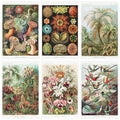
Ernst Haeckel: Beauty and Truth in Nature
In 1866, Ernst Haeckel coined the word ecology. In 1874, he proposed that ontogeny recapitulates phylogeny — that the development of an individual organism replays the evolutionary history of its species. In 1899, he began publishing Kunstformen der Natur — Art Forms in Nature — a work that would prove more lastingly influential than either of those ideas, not in science, but in art, architecture, and design. Haeckel was many things: a biologist of extraordinary range, a polemicist, a philosopher, a controversialist. But it is as a visual thinker — a man who believed that the deepest truths of nature were also its most beautiful forms — that he endures.
The Unity of Beauty and Truth
Haeckel's central philosophical conviction was simple and radical: beauty is not a human imposition on nature, but nature's own deepest principle. The symmetry of a radiolarian, the spiral of a nautilus shell, the branching pattern of a coral — these were not accidents of evolution but expressions of fundamental laws that governed the organization of living matter at every scale. To study nature with scientific precision was, for Haeckel, simultaneously to encounter beauty; and to represent nature with artistic fidelity was to do science.
This conviction placed Haeckel in direct opposition to the dominant tendency of 19th-century science, which increasingly separated the objective description of nature from its aesthetic appreciation. As science professionalized and specialized, the naturalist-artist of the 18th century — the figure exemplified by Goethe, whom Haeckel revered — gave way to the laboratory specialist who regarded aesthetic response as a distraction from rigorous observation. Haeckel refused this separation. For him, the scientist who could not see the beauty of a medusa was missing something essential about what a medusa was.
Monism: The Philosophy Behind the Art
Haeckel's aesthetic philosophy was grounded in a broader metaphysical position he called Monism — the doctrine that matter and spirit, nature and mind, science and art, are not separate realms but aspects of a single unified reality. Against the Cartesian dualism that separated mind from body and humanity from nature, Haeckel argued that consciousness itself was a property of matter, that the boundary between the living and the non-living was a continuum rather than a divide, and that the laws governing the growth of a crystal were continuous with those governing the development of an embryo.
This Monist philosophy had direct consequences for how Haeckel drew. If nature was a unified whole, then the forms of the natural world — from the microscopic to the cosmic — should exhibit the same underlying principles of symmetry, proportion, and organic growth. Kunstformen der Natur was, among other things, a visual argument for Monism: a demonstration, plate by plate, that the same formal principles recurred across radically different organisms and scales, from the six-fold symmetry of a snowflake to the radial symmetry of a sea anemone to the bilateral symmetry of a hummingbird.
The Microscope as Aesthetic Instrument
Haeckel's most original contribution to natural history illustration was his use of the microscope as an aesthetic instrument. Before Haeckel, microscopic organisms — radiolarians, diatoms, foraminifera — were documented in scientific publications with technical accuracy but little aesthetic ambition. Haeckel transformed them into objects of visual wonder.
His plates of radiolarians — single-celled marine organisms with intricate silica skeletons — are among the most extraordinary images in the history of natural history illustration. Haeckel had described over 4,000 radiolarian species in his monumental 1862 monograph, and he returned to them repeatedly throughout his career, finding in their geometric precision — their perfect spheres, their radiating spines, their latticed shells — the clearest visual proof of his conviction that nature's deepest structures were also its most beautiful.
The radiolarian plates in Kunstformen der Natur were not merely scientific documents: they were compositions, arranged with the eye of an artist to reveal the formal relationships between different species, to show how the same underlying geometry could generate an apparently infinite variety of forms. They were, in Haeckel's own phrase, “the most marvelous creations of nature” — and they became, almost immediately, a sourcebook for Art Nouveau designers seeking organic forms to replace the historical ornament of the 19th century.
Haeckel and Goethe: The Morphological Tradition
Haeckel's philosophical roots lay in the German morphological tradition inaugurated by Goethe, whose Metamorphosis of Plants (1790) had argued that all plant forms were variations on a single archetypal form — the Urpflanze, or primal plant. Goethe's morphology was not merely a botanical theory but a philosophical program: an attempt to find the underlying unity of natural forms beneath their apparent diversity.
Haeckel extended this program to the animal kingdom and grounded it in evolutionary theory. Where Goethe had posited an ideal archetype, Haeckel found a historical process: the forms of living organisms were not variations on a timeless ideal but products of evolutionary history, each one shaped by the accumulated modifications of countless generations. But the conviction that underlying unity could be found beneath apparent diversity — that nature, properly understood, was one — was Goethe's, and Haeckel never ceased to acknowledge the debt.
The Legacy: Art, Architecture, and the Natural World
The influence of Kunstformen der Natur on Art Nouveau was immediate and profound. René Binet used Haeckel's radiolarian plates as the direct inspiration for the monumental entrance gate he designed for the 1900 Paris Exposition Universelle. The architect Antoni Gaudí drew on Haeckel's organic forms in his structural innovations at the Sagrada Família. The glassmaker Émile Gallé cited Haeckel as a primary influence on his naturalistic designs. The illustrator Alphonse Mucha's flowing organic lines owe something to the same visual vocabulary that Haeckel had extracted from the microscopic world.
Beyond Art Nouveau, Haeckel's philosophical legacy — the conviction that beauty and scientific truth are inseparable, that the natural world is a unified whole whose forms express fundamental laws — anticipates much of what we now call ecological thinking. His Monism, stripped of its 19th-century metaphysical apparatus, resonates with contemporary understandings of the interconnectedness of living systems and the aesthetic dimensions of scientific knowledge.
To look at a plate from Kunstformen der Natur is to encounter a mind for which seeing and knowing were the same act — for which the careful drawing of a sea anemone was simultaneously a scientific observation, a philosophical argument, and an act of aesthetic devotion to the beauty of the natural world.
Explore six iconic plates from Kunstformen der Natur in our Art Forms in Nature — Ernst Haeckel Kunstformen der Natur 1904 digital collection, ready to print and frame.
References
- Haeckel, E. Kunstformen der Natur. Bibliographisches Institut, Leipzig, 1899–1904.
- Richards, R. J. The Tragic Sense of Life: Ernst Haeckel and the Struggle over Evolutionary Thought. University of Chicago Press, 2008.
- Breidbach, O. Visions of Nature: The Art and Science of Ernst Haeckel. Prestel, 2006.
- Goethe, J. W. von. The Metamorphosis of Plants. MIT Press, 2009 [1790].
- Neret, G. Ernst Haeckel. Taschen, 2000.