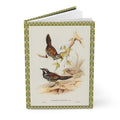
Elizabeth Gould and the Birds of Australia
In 1838, Elizabeth and John Gould sailed for Australia. They spent eighteen months on the continent, collecting specimens, making observations, and drawing from life. When they returned to England, Elizabeth began the work of transferring her field drawings onto lithographic stone — the painstaking process by which the hand-colored prints of The Birds of Australia were produced. She completed 84 of the 681 plates before her death in 1841, at the age of 37, shortly after the birth of her eighth child.

John Gould continued the work without her, employing other artists to complete what she had begun. He acknowledged, in the dedication of the finished work, that without Elizabeth’s contributions it could not have been accomplished. It is a tribute that understates the case. Elizabeth Gould was not merely a contributor to The Birds of Australia. She was its animating spirit — the artist whose eye and hand gave the work its distinctive quality of life.
Elizabeth Gould: The Illustrator Behind the Work
Elizabeth Coxen was born in 1804 and married John Gould in 1829. She had no formal scientific training, but she had an extraordinary natural gift for observation and draughtsmanship, and she threw herself into the work of scientific illustration with a dedication that matched her husband’s ambition.
The lithographic process she mastered was technically demanding. It required drawing in reverse on a heavy limestone block, using a greasy crayon that would accept ink while the blank areas of the stone repelled it. The drawing had to be precise — errors could not easily be corrected — and it had to capture not just the appearance of the bird but its character: the way it held itself, the quality of its plumage, the relationship between the bird and its environment.
Elizabeth Gould did all of this from specimens — skins and skeletons brought back from the field — and from her own field observations during the Australian expedition. The result was a body of work that combined scientific accuracy with a quality of life and movement that distinguished her plates from those of her contemporaries.
The Birds of Australia: A Landmark of Victorian Science
The Birds of Australia was published in parts between 1840 and 1869, eventually comprising eight volumes and 681 hand-colored lithographic plates. It was the most comprehensive ornithological survey of the Australian continent ever produced, and it remained the standard reference work for Australian birds for decades after its completion.
The work was produced at a moment when Australia was still largely unknown to European science. The continent’s fauna was extraordinary — unlike anything that European naturalists had encountered — and the task of documenting it required not just scientific rigor but a willingness to look at the world with fresh eyes. Elizabeth Gould had this quality in abundance. Her plates do not impose European conventions on Australian birds; they meet the birds on their own terms, capturing the particular quality of each species with a precision and sympathy that remains remarkable.
Plate: Chestnut Quail-thrush, Cinclosoma castanotum
The Chestnut Quail-thrush (Cinclosoma castanotum) is a largely ground-based bird of Australia’s semi-arid interior, preferring to run rather than fly, foraging for insects and seeds among mallee woodlands on stony ground. Elizabeth Gould’s lithograph depicts both male and female with the meticulous accuracy that defined her work: the distinctly marked male with its white eyebrow, black throat and breast, and deep chestnut back; the duller female with her grey throat and breast. The composition captures both the scientific detail and the living character of the species with equal mastery.
Plate: White-bellied Flycatcher, Monarcha albiventris
The White-bellied Flycatcher (Monarcha albiventris) is shown in two depictions: one bird perched on a branch, another in mid-flight. Males display glossy blue-black heads, backs, and tails, with a deep rusty red throat and chest, and a clean white belly. The bird in flight is rendered with a dynamism rare in ornithological prints of the period — a quality that speaks to Elizabeth Gould’s exceptional ability to convey movement and life within the formal constraints of scientific illustration.
A Legacy Recovered
Elizabeth Gould’s contribution to The Birds of Australia was long overshadowed by her husband’s fame. John Gould was a celebrated figure in Victorian natural history — a Fellow of the Royal Society, a friend of Darwin, a man whose name was attached to dozens of species. Elizabeth was known, if at all, as his wife and assistant.
Recent scholarship has begun to recover her reputation. Her plates are now recognized as among the finest in the work — distinguished by a quality of observation and a sensitivity to the living bird that reflects her direct experience of the Australian field. She was not an assistant. She was a scientist and an artist of the first order, whose early death deprived Victorian natural history of one of its most gifted practitioners.
Her plates endure. The Chestnut Quail-thrush and the White-bellied Flycatcher, rendered with such care and precision in 1848, are still there — in the mallee woodlands and open forests of Australia, living the lives that Elizabeth Gould documented with such extraordinary fidelity.