Elizabeth Blackwell and the Making of A Curious Herbal (1739)
In 1737, a woman with no formal scientific training walked into the Chelsea Physic Garden in London, sat down with her sketchbook, and began drawing plants. Two years later, she had produced one of the most celebrated botanical works of the eighteenth century — entirely on her own.

A Debt, a Garden, and a Decision
Elizabeth Blackwell (c. 1707–1758) was born in Aberdeen, Scotland, and married Alexander Blackwell, a physician and writer whose ambitions consistently outpaced his means. By the mid-1730s, Alexander had accumulated debts severe enough to land him in Marshalsea, London's notorious debtor's prison. Elizabeth, left without income and with a husband behind bars, devised an audacious plan: she would produce a new illustrated herbal — a reference work identifying medicinal plants — and sell it by subscription to apothecaries, physicians, and naturalists across Britain.
The timing was propitious. The existing standard references, such as John Gerard's Herball (1597) and Nicholas Culpeper's Complete Herbal (1653), were outdated and botanically unreliable. The medical community needed a modern, accurate, and visually precise guide to medicinal plants. Blackwell saw the gap and filled it.
The Making of A Curious Herbal
Between 1737 and 1739, Elizabeth Blackwell rented lodgings adjacent to the Chelsea Physic Garden — one of England's foremost botanical institutions, founded in 1673 by the Worshipful Society of Apothecaries. There, under the guidance of the garden's curator Philip Miller, she drew each plant from life, transferring her sketches onto copper plates, engraving them herself, and then hand-coloring each printed impression.
The process was extraordinary in its demands. Botanical engraving required not only artistic skill but scientific precision: the proportions of leaves, the structure of flowers, the texture of bark and root all had to be rendered with enough accuracy to allow identification. Blackwell had no formal training in engraving; she taught herself. The result, published in weekly installments of four plates each, eventually comprised 500 hand-colored copper engravings across two folio volumes.
A Curious Herbal was dedicated to Sir Hans Sloane, the president of the Royal College of Physicians and one of the most influential naturalists of the era — a strategic choice that lent the work immediate credibility. Sloane's endorsement helped secure the subscriptions that kept the project financially viable and, ultimately, freed Alexander Blackwell from prison.
Scientific Reception and Legacy
The herbal was received with genuine respect by the scientific community. The Royal College of Physicians formally approved it as a reliable reference, a remarkable endorsement for a work produced by a woman outside the established networks of natural philosophy. It was later translated into Latin and German, with expanded editions published in Nuremberg between 1750 and 1773 under the title Herbarium Blackwellianum, edited by the German botanist Christoph Jakob Trew — a testament to its enduring authority across European medical and botanical circles.
Botanically, Blackwell's illustrations reflect the pre-Linnaean tradition: plants are identified by their common and Latin names, their medicinal properties, and their place in the apothecary's repertoire, rather than by the binomial nomenclature that Carl Linnaeus would systematize in his Species Plantarum of 1753. Yet the accuracy and elegance of her draughtsmanship have ensured that the plates remain visually and scientifically legible to this day.
The Melon Plate and the Art of Observation
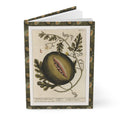
Among the 500 plates, the melon (Cucumis melo) stands as a particularly fine example of Blackwell's observational method. The illustration captures the fruit in cross-section alongside its vine, flower, and seed — a compositional approach that communicates the plant's full botanical identity within a single image. The hand-coloring, applied with watercolor washes over the engraved lines, gives the flesh of the melon a luminous, almost tactile quality that no purely printed image of the period could achieve.
This attention to the whole plant — root, stem, leaf, flower, fruit — was not merely aesthetic. It reflected the functional logic of the herbal tradition, in which every part of a plant might carry distinct medicinal properties and therefore required accurate documentation.
A Complicated Aftermath
Elizabeth Blackwell's story does not end tidily. Having secured her husband's release, she continued to work as an illustrator. Alexander, meanwhile, traveled to Sweden, where he became embroiled in a political conspiracy and was executed in Stockholm in 1747. Elizabeth outlived him by more than a decade, dying in 1758. History has been slow to restore her to the prominence she deserves; for much of the eighteenth and nineteenth centuries, A Curious Herbal was discussed primarily in relation to its male endorsers and editors, with Blackwell's own authorship treated as incidental.
Contemporary scholarship in the history of science has begun to correct this. Blackwell is now recognized as a significant figure in the tradition of women's contribution to natural history illustration — a tradition that also includes Maria Sibylla Merian, Anna Children, and later Marianne North — and as a practitioner whose technical accomplishment was, by any measure, exceptional.

The melon plate from Elizabeth Blackwell's A Curious Herbal (1739) is reproduced on the cover of our Elizabeth Blackwell Melon Hardcover Journal — a 150-page lined notebook that carries one of the eighteenth century's most precise botanical illustrations into everyday use.
Further Reading
- Blackwell, Elizabeth. A Curious Herbal. London: Samuel Harding, 1737–1739.
- Trew, Christoph Jakob, ed. Herbarium Blackwellianum. Nuremberg, 1750–1773.
- Shteir, Ann B. Cultivating Women, Cultivating Science: Flora's Daughters and Botany in England, 1760–1860. Johns Hopkins University Press, 1996.
- Ogilvie, Marilyn, and Joy Harvey, eds. The Biographical Dictionary of Women in Science. Routledge, 2000.
- Schiebinger, Londa. The Mind Has No Sex? Women in the Origins of Modern Science. Harvard University Press, 1989.