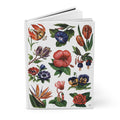
El Tesoro de la Juventud: Eleven Flowers from Four Continents
We know it well by now. El Tesoro de la Juventud — that early twentieth-century encyclopedia that found its way into so many Spanish-speaking homes with its vivid chromolithographic plates — keeps surprising us. This time with one of its most generous pages: eleven ornamental flowers from four continents, gathered on a white background with the clarity and beauty that only the best botanical illustration can achieve.

Eleven species. Four continents. One plate. Let’s take them one by one.
The Eleven Flowers
Strelitzia reginae — Bird of Paradise (South Africa)
The most dramatic of all. Its orange and blue flower head mimics an exotic bird with such precision that it seems almost impossible it is real. Native to the eastern coast of South Africa, it arrived in Europe in the eighteenth century and quickly became a symbol of the extraordinary — the flower that stops you in your tracks.
Camellia japonica — Camellia (East Asia)
Its waxy petals and glossy evergreen leaves represent centuries of refined cultivation in China and Japan. In nineteenth-century Europe, the camellia was the flower of elegance — the one Alexandre Dumas fils immortalised in La Dame aux Camélias. On the plate, it appears with the quiet confidence of something that has always known its own worth.
Lilium martagon — Martagon Lily (Europe and Asia)
Its recurved petals — swept back like a turban — make it instantly recognisable. It grows wild from the Pyrenees to Siberia and was one of the first lilies to be cultivated in European gardens. There is something ancient and slightly mysterious about its form.
Magnolia x soulangeana — Saucer Magnolia (France, 19th century)
A hybrid created in 1820 by Étienne Soulange-Bodin, a Napoleonic officer turned horticulturalist. Its cupped blooms — white inside, pink outside — are one of the great achievements of European horticulture. On the plate it appears in bud, as if keeping its secret a little longer.
Hibiscus rosa-sinensis — Chinese Hibiscus (Tropics)
Large, bold, with that prominent central pistil that makes it unmistakable. The national flower of Malaysia and one of the most widely cultivated plants in warm climates worldwide. On the plate, its presence is immediate — it does not wait to be noticed.
Fuchsia — Lady’s Eardrops (Central and South America)
Its pendant two-toned flowers hang like jewellery from the stem. It arrived in Europe from the Americas in the eighteenth century and became one of the favourite ornamental plants of the Victorian era — a staple of cottage gardens and hanging baskets from Cornwall to Buenos Aires.
Anemone coronaria — Poppy Anemone (Mediterranean)
Simple petals and a dark centre, like a poppy that decided to be a little more refined. Native to the Mediterranean, it blooms in spring and has been cultivated in European gardens since the Renaissance. Its name comes from the Greek: daughter of the wind.
Viola x wittrockiana — Pansy (Europe)
The most democratic flower in the garden. Cheerful, resilient, available in almost every colour imaginable. Its “face” — those dark markings that look like eyes — makes it immediately recognisable. From Buenos Aires to Madrid, the pansy is a constant presence on balconies and in garden beds.
Ipomoea purpurea — Common Morning Glory (Americas)
It climbs walls and fences with its vivid purple trumpet flowers, opening each morning and closing by midday. Native to Central and South America, it naturalised across Europe and became one of the most popular climbing plants of the romantic garden tradition.
Cyclamen — Cyclamen (Mediterranean)
Its downward-facing flowers — as if looking at the ground with a certain shyness — and its marbled leaves give it a particular elegance. It grows in Mediterranean woodlands and is one of the few ornamental plants that blooms in the depths of winter.
Tulipa — Marbled Tulip (Europe)
A garden tulip with streaked and mottled petals — the type that in the seventeenth century triggered the Dutch tulip mania, when a single bulb could be worth more than a house. On the plate it appears with the composure of something that knows exactly what it is worth.
The White Background
What makes this plate particularly luminous is its white background — a choice that gives each flower maximum clarity and presence. Without the warm or atmospheric backgrounds of other botanical illustrations of the period, each species stands alone, with the confidence of something that needs no decoration. The result is a page that functions simultaneously as a scientific reference and as a decorative object — exactly what El Tesoro de la Juventud always did better than anyone.
The Floral Journal preserves that white background in its full-wrap cover design, front and back identical, letting the eleven flowers speak for themselves every time you pick it up.