El Tesoro de la Juventud: The Encyclopedia That Taught a Continent to Love Learning
There are books that furnish a room, and books that furnish a mind. El Tesoro de la Juventud — The Treasure of Youth — was both. For most of the twentieth century, this Spanish-language encyclopedia sat on the bookshelves of families across Latin America and Spain, its volumes consulted for school projects, read for pleasure on rainy afternoons, and passed down from parents to children as a kind of intellectual inheritance. It was, for millions of readers, the first place they learned that the world was larger, stranger, and more beautiful than they had imagined.

Published in multiple editions from the 1910s onward by W. M. Jackson, El Tesoro de la Juventud was conceived as a complete education in a box: history, geography, science, literature, art, and natural history, all gathered between covers and made accessible to young readers without sacrificing depth or accuracy. Its illustrations were among its greatest glories — chromolithographic plates of extraordinary richness, combining scientific precision with the warm, generous aesthetic of popular publishing at its finest.
The Edible Fruits Plate
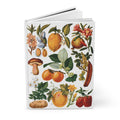
Among the most beloved of these illustrations is the edible fruits and plants plate — a single page that gathers nine species not by botanical classification but by human utility. Everything here is gathered because it feeds us: the almond tree (Prunus dulcis) with its pink blossoms and grey-green husks; the lemon or citron (Citrus) with its rough, textured skin; the pomegranate (Punica granatum) with its brilliant red flowers and characteristic crown; the porcini mushroom (Boletus edulis) with its thick stem and brown cap; the medlar (Mespilus germanica) with its orange fruits and distinctive leaves; the carob tree (Ceratonia siliqua) with its long dark pods; the potato (Solanum tuberosum) with its white flowers and underground tuber; the melon (Cucumis melo) with its yellow flower and climbing tendrils; and the sweet pepper (Capsicum annuum) in vivid, unmistakable red.
It is a delightfully practical vision of the edible world. The porcini mushroom and the potato sit alongside true fruits not because they belong to the same botanical family, but because they belong on the same table. This is the encyclopedic spirit at its most human: organized not by taxonomy but by appetite, not by science alone but by the knowledge that feeds us every day.
A Century of Curiosity
What made El Tesoro de la Juventud so enduring was not merely its content but its tone. It spoke to young readers as intelligent, curious people capable of understanding the world in all its complexity — and it did so with warmth, generosity, and a genuine delight in the act of learning. The natural history plates, in particular, combined scientific accuracy with an aesthetic richness that made them objects of beauty as well as knowledge.
The edible fruits plate is a perfect example. Each species is rendered with the precision of a botanical monograph and the warmth of a kitchen garden: you can almost smell the almond blossom, feel the rough skin of the citron, taste the sweetness of the pomegranate. It is an illustration that rewards careful looking — every viewing reveals a new detail, a new connection between the species gathered on the page.
A Legacy on Every Bookshelf
For readers who grew up with El Tesoro de la Juventud, the edible fruits plate is more than a botanical illustration — it is a memory. It is the smell of old paper and the weight of a heavy volume; it is a Sunday afternoon spent reading about almonds and pomegranates while the world outside went about its business. It is, in the truest sense, a treasure.
That legacy lives on in every careful look at the plate, in every almond blossom and pomegranate crown and carob pod. The world is larger, stranger, and more beautiful than we imagined — and El Tesoro de la Juventud was one of the first places many of us learned to believe it.