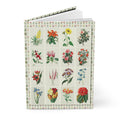
Edwards’s Botanical Register: Sarah Drake and the Art of Victorian Horticulture
In 1815, the year of Waterloo and the end of the Napoleonic Wars, a London publisher launched a new horticultural magazine that would document the extraordinary flowering of British garden culture over the next three decades. Edwards’s Botanical Register — founded by the Welsh botanical artist Sydenham Edwards and later edited by the botanist John Lindley — ran until 1847, producing 33 volumes of hand-colored copper engravings that captured the exotic plants arriving in British gardens from every corner of the world. It was the premier illustrated horticultural publication of its era, and its plates remain among the finest examples of 19th-century botanical art.

The Floral Journal from LeBonJournal celebrates two of those plates: a mosaic of ten botanical specimens on the front cover and sixteen on the back, together representing the full range of the Register’s extraordinary scope — from Mexican sunflowers to Chinese azaleas, from Peruvian lilies to two-edged Laelia orchids.
Sydenham Edwards and the Founding of the Register
Sydenham Edwards (1768–1819) was one of the most gifted botanical artists of his generation. Born in Wales, he came to London as a young man and quickly established himself as the principal illustrator for Curtis’s Botanical Magazine, the leading botanical publication of the late 18th century, for which he produced nearly 1,700 plates over more than two decades. When he founded his own register in 1815, he brought with him the standards of accuracy and artistic quality that had made Curtis’s the benchmark for botanical illustration.
Edwards died in 1819, just four years after founding the Register, but the publication continued under the editorship of John Lindley — one of the most important botanists of the 19th century, a professor at University College London and a key figure in the development of modern plant taxonomy. Under Lindley’s direction, the Register became increasingly rigorous in its scientific content while maintaining the artistic quality that had always been its hallmark.
Sarah Drake: Over a Thousand Plates
The most prolific contributor to Edwards’s Botanical Register was Sarah Anne Drake (1803–1857), a botanical artist who worked closely with John Lindley and produced more than 1,000 of the Register’s plates during her career. Drake’s work is remarkable for its combination of scientific precision and artistic warmth — the ability to render the exact structure of a flower’s petals, stamens, and leaves while also capturing something of its living presence, the quality of light on a petal, the particular way a stem bends under the weight of a bloom.
She worked primarily with hand-colored copper engravings — a technique that required the engraver to incise the image into a copper plate, print it in black ink, and then hand-color each copy individually. The result was a level of color nuance and detail that chromolithography, for all its advantages, could not always match. Each copy of the Register was, in a sense, a unique object — colored by hand, with the slight variations that hand-work always introduces.
The Front Cover: Ten Botanical Specimens
The front cover mosaic brings together ten of the Register’s most striking plates: Lilium thunbergianum (Thunberg’s Orange Lily), Alstroemeria (Peruvian Lily), Rosa multiflora (Seven Sisters Rose), Rhododendron indicum (Brick Red Chinese Azalea, 1834), Tithonia tubaeformis (Trumpet Stalked Sunflower, 1832), Erigeron speciosus (Aspen Fleabane), Bistorta amplexicaulis (Red Bistort), Tulipa scabriscapa (Rough Stemmed Tulip), and Crataegus (Hawthorn). Together they represent the global reach of Victorian botanical exploration — plants from China, Peru, Mexico, and the mountains of Europe, all cultivated in British gardens and documented with Sarah Drake’s characteristic precision.
The Back Cover: Sixteen More
The back cover extends the survey with sixteen additional specimens, including Allium caeruleum (Blue Leek), Laelia anceps (Two-Edged Laelia Orchid), Paeonia suffruticosa (Moutan Peony, 1835), Coreopsis tinctoria (Golden Coreopsis), and various campanula and gloxinia varieties. The orchids and peonies in particular represent the two great obsessions of Victorian horticulture — the exotic and the opulent — while the campanulas and gloxinias speak to the quieter pleasures of the cottage garden tradition.
The Golden Age of British Horticulture
The years between 1815 and 1847 — the lifespan of Edwards’s Botanical Register — were the golden age of British horticulture. Plant hunters were returning from expeditions to China, South America, and Australia with species that had never been seen in European gardens. The great glasshouses of Kew and Chatsworth were being built to house tropical plants that could not survive the British winter. The middle classes were discovering the pleasures of gardening, and publications like the Register were there to guide and inspire them.
Sarah Drake’s plates documented this world with a fidelity and beauty that no other medium of the era could match. They are records of a moment when the British garden was at its most ambitious and most cosmopolitan — when a gardener in London could cultivate a Peruvian lily alongside a Chinese azalea and a Mexican sunflower, and find all three illustrated with equal care in the pages of a single magazine.
The Floral Journal carries that legacy. 150 lined pages, a binding that lays flat, paper that takes fountain pen and pencil with equal grace. A cover that reminds you, every time you pick it up, that the garden has always been the most international of art forms.