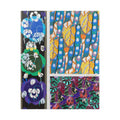
Édouard Bénédictus and the Variations: Art Déco Pattern Design in 1920s Paris
In the spring of 1928, a Parisian designer named Édouard Bénédictus published a portfolio that would become one of the defining documents of the Art Déco movement. Variations Quatre-Vingt-Six Motifs Décoratifs En Vingt Planches — Eighty-Six Decorative Motifs in Twenty Plates — was not a manifesto or a theoretical treatise. It was something more immediate and more useful: a collection of patterns, each one a complete decorative world, offered to the designers, manufacturers, and tastemakers of an era that was hungry for exactly this kind of visual invention.
The Man Behind the Motifs
Édouard Bénédictus (1878–1930) was one of those figures who seem to belong entirely to their moment. Born in Paris, he trained as a painter but found his true vocation in the applied arts — the world of textiles, wallpapers, bookbindings, and decorative objects that the French called arts décoratifs and that the rest of the world would come to know as Art Déco.
He was also, by a curious accident of history, one of the inventors of safety glass. In 1903, Bénédictus noticed that a glass flask coated with cellulose nitrate had shattered without scattering its fragments, and he patented the process that would eventually make laminated glass a standard feature of automobile windscreens. The royalties from this invention gave him the financial independence to pursue his decorative work without commercial pressure — a freedom that is visible in the extraordinary ambition of the Variations.
The Visual Language of Art Déco
The Art Déco movement that Bénédictus inhabited was not a single style but a conversation — between tradition and modernity, between the organic curves of Art Nouveau and the geometric rigour of Cubism, between the luxury crafts of the ancien régime and the machine aesthetics of the new century. What united its practitioners was a commitment to beauty as a serious enterprise, and to the decorative arts as a domain worthy of the same creative ambition as painting or sculpture.
The great showcase of this ambition was the Exposition Internationale des Arts Décoratifs et Industriels Modernes of 1925 — the Paris exhibition that gave the movement its name and established France as the world capital of decorative design. Bénédictus exhibited there, and the Variations of 1928 can be read as a distillation of everything that exhibition represented: the confidence, the chromatic boldness, the fusion of geometric and organic forms that defined the Art Déco moment at its height.
The Eighty-Six Motifs
The Variations are organised in twenty plates, each presenting several related motifs. The range is extraordinary. Some designs are purely geometric — interlocking diamonds, chevrons, stepped forms derived from the architecture of Aztec temples and Egyptian monuments that had captured the Parisian imagination after the discovery of Tutankhamun's tomb in 1922. Others are floral, but flowers transformed by the Art Déco sensibility into something more abstract, more rhythmic, more insistently decorative than any naturalistic botanical illustration.
The colour palette is equally varied. Bénédictus worked with the full chromatic range available to the pochoir (stencil) printing technique — a method that allowed flat, saturated colours to be applied with extraordinary precision. Burnt oranges, deep teals, warm golds, vivid crimsons, and the particular shade of black that Art Déco designers used not as an absence of colour but as a colour in its own right: these are the hues that give the Variations their immediate visual impact.
Influence and Legacy
The Variations were designed to be used. They were a resource for the textile manufacturers of Lyon, the wallpaper designers of Paris, the ceramicists and metalworkers and bookbinders who needed a constant supply of new patterns to satisfy the appetite of a market that demanded novelty and quality in equal measure. In this sense, Bénédictus was working in a tradition that stretched back through Owen Jones's Grammar of Ornament (1856) and the pattern books of the Arts and Crafts movement to the Renaissance pattern books that had first systematised the decorative arts as a discipline.
But the Variations were also, unmistakably, works of art in their own right. Each motif is a complete composition — balanced, resolved, satisfying in the way that a good painting or a good piece of music is satisfying. Bénédictus died in 1930, just two years after their publication, but the Variations have endured as one of the most complete expressions of the Art Déco decorative imagination — eighty-six answers to the question of what beauty looked like in 1920s Paris.
References: Duncan, A. Art Déco. London: Thames & Hudson, 1988. — Lesieutre, A. The Spirit and Splendour of Art Déco. New York: Paddington Press, 1974. — Troy, N. Modernism and the Decorative Arts in France: Art Nouveau to Le Corbusier. Yale University Press, 1991.
Four of Bénédictus's most celebrated Variations — Variations 5, 8, 11, and 15 — are available as jigsaw puzzles in the Bénédictus Art Déco Puzzle Collection, from 110 to 1014 pieces.