Earth Day: A Celebration of the Only Home We Have
Share
Every April 22nd, something remarkable happens: millions of people across more than 190 countries pause to look at the world beneath their feet — and above their heads — and remember that it is worth protecting.
When and Why
Earth Day is celebrated on April 22nd each year. The first Earth Day took place on April 22, 1970, in the United States, organized by Senator Gaylord Nelson following a massive oil spill off the coast of Santa Barbara, California, in 1969. That disaster — and the growing awareness of industrial pollution, smog, and the disappearance of wild species — galvanized a generation. On that first Earth Day, an estimated 20 million Americans took to the streets, parks, and university campuses. It is widely considered the birth of the modern environmental movement.
By 1990, Earth Day had gone global, mobilizing 200 million people in 141 countries. In 2009, the United Nations officially designated April 22nd as International Mother Earth Day. Today, it is coordinated by the nonprofit EARTHDAY.ORG and remains the largest civic event on the planet.
What It Means
Earth Day is not a single cause — it is a convergence of many. Over the decades, its themes have expanded to encompass the full complexity of our relationship with the natural world:
- Climate change and carbon emissions, and the urgent need to transition to renewable energy
- Biodiversity loss, including the accelerating extinction of plant and animal species
- Plastic pollution in oceans, rivers, and soil
- Deforestation and the destruction of ecosystems that regulate the climate
- Environmental justice, recognizing that the communities most affected by pollution and climate disruption are often the least responsible for causing them
- Science literacy and education, because understanding the Earth is the first step toward protecting it
Each year, EARTHDAY.ORG announces a specific theme. The 2025 theme was Our Power, Our Planet, a call for a tripling of renewable energy by 2030. The 2026 theme continues in that spirit, urging collective action at every scale — from individual choices to international policy.
The Earth We Are Learning to See Again
There is something quietly profound about the fact that the environmental movement and the space age grew up together. The first Earth Day came just months after the Apollo 12 mission. The famous Earthrise photograph — taken by astronaut William Anders during Apollo 8 in December 1968 — is often credited with changing how humanity perceived its own planet: a small, luminous sphere suspended in darkness, fragile and singular.
That perspective is about to be renewed. NASA's Artemis II mission, currently scheduled for 2026, will carry four astronauts on a journey around the Moon — the first crewed lunar flyby in more than fifty years. Among them will be the first woman and the first person of color to travel to deep space. When they look back at Earth from that distance, they will see what the Apollo astronauts saw: no borders, no noise, only the blue-and-white marble that is home to every living thing we have ever known.
It is a fitting reminder for Earth Day. The overview effect — the cognitive shift reported by astronauts when they see Earth from space — is not a luxury reserved for those who leave the atmosphere. It is available to anyone willing to look carefully at the world around them: at a river, a forest, a geological stratum, a botanical illustration made two centuries ago by someone who understood that documenting nature was a form of devotion.
A Note on Observation
Some of the most enduring acts of environmental care have been quiet ones: the naturalists who spent decades cataloguing species before anyone called it conservation, the cartographers who mapped coastlines and mountain ranges with painstaking precision, the illustrators who rendered the natural world in ink and watercolor so that future generations might know what once existed.
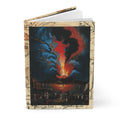
That tradition of careful attention lives on. If you keep a journal — whether for field notes, sketches, reflections, or simply the habit of noticing — you might find that some of our geology and natural history journals make fitting companions for the season. They carry that same spirit of observation on their covers.
And if you have been thinking about adding one to your collection, our Deals section has a 10% discount running through the end of April — a small way to mark the occasion.
Further Reading
- Nelson, Gaylord. Earth Day: The Beginning. Praeger, 1970.
- Carson, Rachel. Silent Spring. Houghton Mifflin, 1962.
- EARTHDAY.ORG. The History of Earth Day. earthday.org/history
- White, Frank. The Overview Effect: Space Exploration and Human Evolution. AIAA, 1987.
- NASA. Artemis II Mission Overview. nasa.gov/artemis