The de Bry Dynasty: Frankfurt’s Greatest Publishing Family and the Florilegium Novum of 1611
In the history of European publishing, few family names carry the weight of de Bry. For three generations, the de Bry family operated from Frankfurt as engravers, publishers, and visual chroniclers of a world in transformation — producing works that documented the Americas, the natural world, and the exotic flowers arriving from the Ottoman Empire with equal ambition and technical mastery. The Florilegium Novum of 1611, published by Johann Theodor de Bry, is one of the most beautiful products of that tradition: a floral pattern book that captured the botanical enthusiasm of the Dutch Golden Age in copper-plate engravings of extraordinary refinement.

Theodor de Bry and the Frankfurt Tradition
The dynasty began with Theodor de Bry (1528–1598), a Flemish goldsmith and engraver who fled religious persecution in Liège and eventually settled in Frankfurt, where he established the publishing house that would bear his name. Theodor was a man of extraordinary ambition: his Grand Voyages and Petits Voyages — illustrated accounts of European exploration in the Americas, Africa, and Asia — were among the most influential publications of the late 16th century, shaping European perceptions of the wider world for generations.
Theodor’s technical mastery of copper-plate engraving set the standard for the family’s work. The copper-plate process — in which an image is incised into a copper plate, inked, and pressed onto paper — allowed for a precision and delicacy that woodblock printing could not match. The de Bry family used it to document everything from the indigenous peoples of the Americas to the exotic flowers of the Ottoman Empire with the same meticulous attention to detail.
Johann Theodor de Bry and the Florilegium Novum
Johann Theodor de Bry (1561–1623) inherited both his father’s publishing house and his technical skill. In 1611, he published the Florilegium Novum — a collection of floral engravings that documented the exotic bulbs and flowers that were transforming European gardens at the height of the Dutch Golden Age’s botanical enthusiasm.
The timing was significant. The late 16th and early 17th centuries saw an extraordinary influx of exotic plants from the Ottoman Empire into Northern Europe, facilitated by the diplomatic and commercial networks of the Habsburg court and the botanical networks centred on the Leiden botanical garden. Tulips, hyacinths, fritillaries, and anemones — flowers that had never been seen in Northern Europe before — were arriving in the gardens of wealthy collectors, and the demand for accurate visual documentation of these novelties was intense.
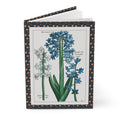
The Florilegium Novum met that demand with the full resources of the de Bry engraving tradition. The plates — including the two hyacinth plates that appear on this journal — combined botanical accuracy with decorative elegance, framing the flower specimens within ornamental borders that reflected the aesthetic values of early Baroque Frankfurt. They were not merely scientific documents but works of art, designed to be collected and admired as well as consulted.
The Hyacinth and the Ottoman Connection
Hyacinthus orientalis — the Oriental hyacinth — was one of the most prized of the Ottoman bulbs arriving in Northern Europe in the early 17th century. Native to the eastern Mediterranean and cultivated for centuries in Ottoman gardens, it arrived in Europe through the same networks that brought the tulip, and it generated a similar enthusiasm among collectors.
The hyacinth’s fragrance — intense, sweet, unmistakable — made it particularly desirable. Unlike the tulip, which was prized primarily for its visual qualities, the hyacinth engaged multiple senses simultaneously. The blue and white varieties documented in de Bry’s Plates 57 and 58 were among the most sought-after, their cool colours and delicate form making them ideal subjects for the copper-plate engraver’s art.
The de Bry Legacy
The de Bry family’s influence extended beyond their own publications. Johann Theodor’s granddaughter — through his son Johann Israel — was Maria Sibylla Merian (1647–1717), one of the greatest naturalist illustrators of the 17th century, whose Metamorphosis Insectorum Surinamensium (1705) transformed the scientific understanding of insect life cycles. The de Bry tradition of precise, beautiful natural history illustration runs directly through Merian’s work, connecting the Florilegium Novum of 1611 to the scientific revolution of the late 17th century.
The Florilegium Novum itself remained influential for decades after its publication. Its plates were copied, adapted, and referenced by subsequent botanical illustrators, and its combination of scientific accuracy and decorative elegance set a standard that shaped European botanical publishing for a generation.

Our Johann Theodor de Bry Hyacinth Journal carries Plates 57 and 58 from the Florilegium Novum — the Oriental hyacinth documented by Frankfurt’s greatest publishing dynasty at the height of the Dutch Golden Age.
References
- Meganck, Tine Luk. Erudite Eyes: Friendship, Art and Erudition in the Network of Abraham Ortelius. Brill, 2017.
- Pavord, Anna. The Tulip. Bloomsbury, 1999.
- Ogilvie, Brian W. The Science of Describing: Natural History in Renaissance Europe. University of Chicago Press, 2006.
- De Bry, Johann Theodor. Florilegium Novum. Frankfurt, 1611.