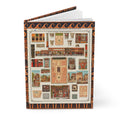
The House That Pompeii Preserved: Cybulski’s 1897 Plates and the Architecture of Ancient Domestic Life
When Vesuvius buried Pompeii in 79 CE, it did something no archaeologist could have planned: it preserved, beneath four metres of volcanic ash, the most complete record of Roman domestic life that has ever survived. The houses of Pompeii — their floor plans, their wall paintings, their mosaics, their furniture arrangements — give us a picture of how Romans actually lived that no literary source could provide. And when the classical scholar Stephanus Cybulski set out, in the 1890s, to create the definitive educational plates of Greek and Roman antiquity, it was to Pompeii that he turned for the Roman house.

Stephanus Cybulski and the Tabulae
Cybulski’s Tabulae quibus antiquitates graecae et romanae illustrantur — Plates Illustrating Greek and Roman Antiquities — was one of the great educational publishing projects of the late nineteenth century. Produced between approximately 1897 and 1906, the series was designed for use in European schools and universities as a visual companion to the study of classical civilization: a set of large-format lithographic plates that could be displayed in the classroom, consulted in the library, and used to teach archaeology, architecture, and daily life through image rather than text alone.
The plates combined the precision of archaeological scholarship with the clarity of the finest educational illustration. Every floor plan, every column capital, every decorative detail was drawn with the accuracy that decades of excavation at Pompeii, Athens, and other sites had made possible. The result was a series that remained in use in European classrooms well into the twentieth century — a testament to the quality of Cybulski’s scholarship and the skill of his illustrators.
The Domus Romana — Domus Pompeiana (Tabla XI)
The Roman house plate is organized around the discoveries at Pompeii, which had been under systematic excavation since the eighteenth century and by the 1890s had yielded an extraordinary picture of elite Roman domestic life.
At the center of the plate is the floor plan of a Pompeian domus — the standard form of the Roman elite house, organized around two open spaces: the atrium and the peristylum. The atrium was the public heart of the house, the space where the paterfamilias received clients and conducted business. Its roof sloped inward to a central opening — the compluvium — which admitted light and rain into the impluvium, the shallow pool below. The tablinum, the master’s study and reception room, opened directly off the atrium; the triclinium, the dining room where guests reclined on couches to eat, lay beyond.
The peristylum was the private garden at the rear of the house — a colonnaded courtyard planted with flowers and fountains, the domestic equivalent of the public portico, a space of shade and beauty in the Mediterranean heat.
The plate also shows the street-level face of the Pompeian house: the vestibulum, the entrance passage that separated the public street from the private interior, and the threshold mosaics that marked the boundary between outside and inside. The most famous of these is the Cave Canem — Beware of the Dog — a mosaic of a chained dog found at the entrance of the House of the Tragic Poet in Pompeii, one of the most reproduced images of Roman domestic life and a reminder that the ancient house, for all its grandeur, was also a home.
The Oikia Ελληνική — The Greek House
The Greek house plate presents a different domestic world — older, less well preserved, but reconstructed by Cybulski’s scholars with the same archaeological precision.
The Greek house was organized around the aule — the central courtyard — rather than the Roman atrium. The Mezon Megaron, the great hall, was the principal reception space; the Oikia Attikh, the Attic house, represents the standard form of the Athenian domestic interior. The plate shows multiple residential layouts, allowing the viewer to understand the range of Greek domestic architecture across different regions and periods.
But the most striking element of the Greek house plate is its treatment of color. One of the great revelations of nineteenth-century classical archaeology was the discovery that ancient Greece was not the world of white marble that Renaissance and Enlightenment imagination had constructed. Greek temples, sculptures, and houses were painted in vivid polychrome — reds, blues, yellows, and greens applied to surfaces that centuries of weathering had stripped bare. Cybulski’s plate includes polychrome reconstructions of wall paintings and decorative patterns, including the celebrated Greek meander — the geometric key pattern that has become one of the most recognizable symbols of classical antiquity — shown in the colors it would originally have carried.
The three classical orders — Doric, Ionic, and Corinthian — are illustrated in comparative detail, showing the proportions, capitals, and entablatures that defined each style and that architects from the Renaissance to the present day have continued to study and adapt.
Two Houses, Two Civilizations
Together, the Domus Pompeiana and the Oikia Helleniki form a complete portrait of domestic architecture across the two great civilizations of antiquity. They are not ruins but reconstructions — attempts to imagine these spaces as they were lived in, furnished, painted, and inhabited by the people who built them.
What Cybulski understood, and what his plates communicate with extraordinary clarity, is that the ancient world was not a world of monuments. It was a world of houses — of daily life organized around courtyards and dining rooms, threshold mosaics and garden fountains, painted walls and geometric floors. The grandeur of the Parthenon and the Colosseum was built by people who came home every evening to spaces not entirely unlike our own.
The Cave Canem mosaic at the threshold of a Pompeian house is perhaps the most human detail in all of classical archaeology: a warning, a joke, a piece of domestic humor preserved by catastrophe for two thousand years. It reminds us that the ancient world was not a ruin but a home — vivid with color, purpose, and daily life.