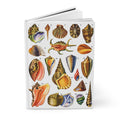
Conchology: The Art and Science of Shells
In the great cabinets of curiosity that lined the walls of 17th-century European collectors — the Wunderkammern that brought together the most extraordinary objects from the natural and artificial worlds — shells occupied a place of special honor. They were among the most beautiful objects that nature produced: geometrically perfect, endlessly varied in form and color, and possessed of a mathematical regularity — the logarithmic spiral of the nautilus, the precise helical twist of the turritella — that seemed to reveal the hidden order of the natural world. They were also, in the age of exploration, among the most exotic: brought back from the Indian Ocean, the Pacific, and the Caribbean by the ships of the great trading companies, they represented the farthest reaches of a world that was only beginning to be mapped and understood. Conchology — the art and science of shells — was born in this moment of wonder, and it has never entirely lost the quality of enchantment that characterized its origins.
The Ancient Trade in Shells
The human fascination with shells is far older than the cabinets of curiosity. Archaeological evidence of shell use — as ornament, as currency, as ritual object — extends back tens of thousands of years, to a time long before the emergence of writing or agriculture. The cowrie shell (Cypraea), with its smooth porcelain surface and distinctive oval form, was used as currency across an extraordinary range of cultures: in ancient China, where cowries were the earliest form of money and the Chinese character for "money" is derived from the image of a cowrie shell; in sub-Saharan Africa, where cowrie shells imported from the Maldives were the dominant currency of the trans-Saharan trade for centuries; and in South Asia and the Pacific, where they served as both currency and ritual object in cultures separated by thousands of miles of ocean.
The Queen Conch (Strombus gigas), with its brilliant pink lip and imposing size, was equally important in the cultures of the Caribbean and Central America: the Maya used conch shells as trumpets in ritual and warfare, and the sound of the conch — a deep, resonant blast that carries over great distances — was associated with the sea god and with the transitions between worlds. The Triton's Trumpet (Charonia tritonis), one of the largest gastropods in the world, served a similar function in the cultures of the Pacific and the Mediterranean: in Greek mythology, Triton, the messenger of the sea, used a conch shell as a trumpet to calm or raise the waves, and the shell appears in the art and ritual of cultures from Japan to Hawaii to ancient Greece.
The Birth of Conchology
As a systematic scientific discipline, conchology emerged in the 17th and 18th centuries, alongside the broader development of natural history as a field of inquiry. The first great conchological collections were assembled by the same collectors who built the cabinets of curiosity: men like Ole Worm in Denmark, whose Museum Wormianum (1655) included an extensive shell collection, and Albertus Seba in Amsterdam, whose four-volume Thesaurus (1734–1765) contained some of the most beautiful natural history illustrations ever produced, including detailed engravings of hundreds of shell species.
The systematic classification of shells was undertaken by the same naturalists who were developing the broader framework of biological taxonomy: Linnaeus included shells in his Systema Naturae (1758), giving Latin binomial names to hundreds of species and establishing the framework within which all subsequent conchological classification would be conducted. The class Gastropoda — the snails and slugs, the largest class of molluscs, with more than 60,000 living species — was defined within this Linnaean framework, and the names that Linnaeus gave to the species he described — Conus geographus, Murex pecten, Charonia tritonis — are still in use today.
The Venus Comb Murex and the Geography Cone
Among the nineteen gastropods depicted in the El Tesoro de la Juventud plate, two stand out for the extremity of their forms. The Venus Comb Murex (Murex pecten) is one of the most extraordinary shells in the world: its long, slender spines — which can number more than a hundred, arranged in rows along the whorls of the shell — are so delicate and so perfectly formed that they seem more like the work of a jeweler than a product of biological growth. The spines are thought to serve as a defense against predators and to prevent the shell from sinking into soft sediment; they are also, in the hands of collectors, among the most fragile and difficult to preserve of any shell species.
The Geography Cone (Conus geographus) presents a very different kind of extremity: it is one of the most venomous animals in the world. The cone snails are predatory gastropods that hunt fish, worms, and other molluscs using a harpoon-like tooth that can inject a complex venom capable of causing paralysis and death in humans. The Geography Cone, whose shell is decorated with a pattern of brown markings that resembles a map — hence its name — is responsible for more human fatalities than any other cone snail species, and collectors have been killed by shells they were holding in their hands. The beauty of the shell and the danger of the animal it houses is one of the most striking paradoxes in the natural history of the ocean.
El Tesoro de la Juventud and the Golden Age of Encyclopedias
El Tesoro de la Juventud — The Book of Knowledge — was first published in Spanish in 1912 by W. M. Jackson, Inc., as a translation and adaptation of the English-language The Book of Knowledge. It became one of the most widely read encyclopedias in the Spanish-speaking world, going through numerous editions and printings over the following decades and reaching millions of readers across Latin America and Spain. Its chromolithographic illustrations — produced with the full resources of early 20th-century color printing technology — were among its most celebrated features: detailed, accurate, and beautiful, they brought the natural world to life for generations of young readers who had no other access to images of the creatures and landscapes of distant seas and continents.
The Gastropoda plate is a characteristic example of the encyclopedia's illustrative approach: nineteen species arranged against a white background that allows each shell's form, texture, and color to be appreciated in full detail, with the scientific names provided for each specimen. It is simultaneously a work of scientific documentation and a work of art — a celebration of the extraordinary diversity of form that the class Gastropoda has produced over five hundred million years of evolution, and a reminder that the ocean has been crafting masterpieces long before any human hand held a brush.

If the world of shells and conchology inspires you, our Seashell Journal — El Tesoro de la Juventud Gastropod Plate brings the Gastropoda plate to the cover of a hardcover journal.
References
- Dance, S. P. A History of Shell Collecting. E. J. Brill, 1986.
- Eisenberg, J. M. A Collector's Guide to Seashells of the World. McGraw-Hill, 1981.
- Linnaeus, C. Systema Naturae, 10th edition. Laurentius Salvius, 1758.
- Seba, A. Locupletissimi Rerum Naturalium Thesauri. Janssonio-Waesbergios, 1734–1765.
- Olivera, B. M. "Conus Venom Peptides." Molecular Biology of the Cell 8 (1997): 2101–2109.