The Dinosaur Book: Colbert, Germann and the Visual Image of Prehistoric Life
In 1945, the American Museum of Natural History published a book for young readers that would shape the way an entire generation imagined the prehistoric world. The Dinosaur Book: The Ruling Reptiles and Their Relatives, written by Edwin H. Colbert and illustrated by John C. Germann, was not the first popular account of dinosaurs — but it was, for several decades, the most authoritative and the most visually compelling. Its black-and-white illustrations defined what dinosaurs looked like in the minds of millions of children who grew up in the postwar years, long before the dinosaur renaissance of the 1970s and 1980s would overturn almost everything those illustrations assumed.
Edwin H. Colbert and the Age of the Ruling Reptiles
Edwin Harris Colbert was one of the most influential American palaeontologists of the twentieth century. Born in Iowa in 1905, he joined the American Museum of Natural History in 1930 and spent the next four decades there, eventually becoming Curator of Fossil Reptiles and Amphibians. His scientific contributions were substantial: he worked extensively on Triassic dinosaurs, described numerous new species, and in 1947 led the expedition to Ghost Ranch, New Mexico, that uncovered one of the most remarkable fossil deposits ever found — hundreds of Coelophysis skeletons preserved together in what appeared to be a mass death event.
But Colbert was also a gifted communicator. He believed that palaeontology belonged to the public as much as to the specialist, and he wrote prolifically for general audiences throughout his career. The Dinosaur Book was his most successful popular work — a systematic survey of the ruling reptiles, from the early Triassic through the end of the Cretaceous, written with the clarity and authority of a scientist who had spent years handling the actual bones.
John C. Germann and the Art of Reconstruction
The illustrations that gave The Dinosaur Book its visual power were the work of John C. Germann, a staff artist at the American Museum. Germann worked in close collaboration with Colbert, producing reconstructions that were as scientifically grounded as the knowledge of 1945 allowed. The animals are shown in plausible landscapes — Jurassic fern prairies, Cretaceous swamps, Triassic uplands — with attention to posture, scale, and ecological context that was unusual for popular science illustration of the period.
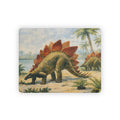
The Stegosaurus plate is characteristic of Germann's approach. The animal is shown in profile, moving left through a landscape of ferns, cycads, and tall palms, with a river and distant mountains in the background. A second Stegosaurus appears in the background, suggesting social behaviour. The double row of bony plates along the spine is rendered with careful attention to their arrangement and relative size. The tail drags along the ground — a detail that reflects the scientific consensus of 1945, when dinosaurs were generally understood to be slow, cold-blooded, and somewhat reptilian in their posture and movement.
That dragging tail is now known to be incorrect. Modern palaeontology has established that dinosaurs held their tails horizontally, clear of the ground, as a counterbalance to the body. But the error is historically significant: it is a record of what the best science of 1945 believed, rendered with the full authority of the American Museum of Natural History. It is a reminder that scientific illustration is always a document of its moment — a reconstruction based on the evidence available, subject to revision as new evidence emerges.
The Postwar Dinosaur
The world into which The Dinosaur Book appeared was one hungry for the kind of wonder that palaeontology could provide. The war had ended. The atomic age had begun. The American Museum of Natural History, with its great fossil halls and its tradition of popular science communication, offered something that the postwar moment needed: a sense of deep time, of a world that had existed long before human conflict and would persist long after it.
Colbert understood this. His prose in The Dinosaur Book is measured and authoritative, but it is also quietly awed — alive to the strangeness of the animals he describes, to the improbability of their existence and the miracle of their preservation in stone. Germann's illustrations amplify that sense of wonder: the dinosaurs are not monsters but animals, going about the business of their lives in landscapes that feel, despite their strangeness, recognisably like the natural world.
Before the Renaissance
The dinosaur renaissance — the revolution in palaeontological thinking that began in the late 1960s with Robert Bakker's arguments for warm-blooded, active dinosaurs and accelerated through the 1970s and 1980s — made Germann's reconstructions look dated almost overnight. The dragging tails, the sluggish postures, the cold-blooded torpor: all of it was overturned by new evidence and new ways of reading the fossil record.
But the images did not disappear. They remained in libraries, in second-hand bookshops, in the memories of everyone who had grown up with them. They are historical documents now — evidence of a particular moment in the history of science, when the best available knowledge produced images of extraordinary beauty and authority that were also, in important ways, wrong. That combination of beauty and error is not a flaw. It is what makes them interesting.
A Legacy in Bone and Paper
Edwin Colbert died in 2001, at the age of ninety-six. He had lived long enough to see the dinosaur renaissance, to revise his own views, and to continue writing for general audiences well into his eighties. John C. Germann's later career is less well documented, but his illustrations for The Dinosaur Book remain his most enduring work — reproduced, referenced, and remembered by everyone who encountered them in childhood.
The Stegosaurus is still there in its Jurassic landscape, still moving left through the ferns and cycads, still dragging its tail along the ground. It is not quite the animal that palaeontology now describes. But it is the animal that a generation grew up with — and that is a kind of truth of its own.

If you would like to bring a little of that wonder home, our Stegosaurus Kids' Puzzle reproduces Germann's 1945 illustration in full colour, hand-colourised for warmth and vividness, in 30 large pieces for children ages 3–7.
References
Colbert, E. H. (1945). The Dinosaur Book: The Ruling Reptiles and Their Relatives. American Museum of Natural History / McGraw-Hill.
Colbert, E. H. (1968). Men and Dinosaurs: The Search in Field and Laboratory. Dutton.
Desmond, A. (1975). The Hot-Blooded Dinosaurs: A Revolution in Palaeontology. Blond & Briggs.
Dodson, P. (1996). The Horned Dinosaurs. Princeton University Press.
Paul, G. S. (2000). The Scientific American Book of Dinosaurs. St. Martin's Press.