Classis II. Diandria: How Linnaeus Taught the World to Read a Flower
I. The Problem of the Plant
Before Linnaeus, the plant kingdom was a chaos of names. A single species might be known by a dozen different names across as many countries; a single name might refer to half a dozen different plants depending on who was writing and where. The herbalists of the sixteenth and seventeenth centuries had accumulated an enormous body of botanical knowledge, but it was knowledge without architecture — a vast, ungoverned accumulation of observation, tradition, and local nomenclature that no single mind could hold.
The problem was not merely practical, though it was that too. It was philosophical. To name a thing is to claim to understand it; to classify it is to claim to understand its relationships. Without a stable system of classification, botany could not be a science in any rigorous sense — it could only be a collection of facts, each one isolated from the others, each one dependent on the memory and authority of a single observer.
Carl Linnaeus (1707–1778) understood this problem with unusual clarity, and he devoted his life to solving it.

II. The Sexual System
Linnaeus's solution was audacious in its simplicity. He proposed to classify all flowering plants according to the number and arrangement of their stamens — the male reproductive organs — and their pistils — the female. The system was called the Systema Sexuale, and it was published in its first form in 1735, when Linnaeus was twenty-eight years old.
The classes of the system were defined by the number of stamens. Monandria: one stamen. Diandria: two stamens. Triandria: three. And so on, up to Polyandria — many stamens — and beyond, into classes defined by the relative lengths of stamens, their fusion, their attachment to the pistil. The orders within each class were defined by the number of pistils.
The result was a system of extraordinary practical utility. To identify an unknown plant, you needed only to count: how many stamens? How many pistils? The answers would place you in a class and an order, and from there the path to the species was, if not always short, at least navigable. A student with no prior botanical knowledge could, in principle, work through the system and arrive at a correct identification.
This was revolutionary. For the first time, botany had a method that could be taught, learned, and applied by anyone willing to look carefully at a flower.
III. Diandria — The Plants of Two Stamens
Classis II. Diandria — the second class of the Linnaean system — comprises all flowering plants with exactly two stamens. It is a small class by the standards of the system, but a botanically remarkable one, because it brings together plants that share almost nothing in appearance, habitat, or use, united only by this single structural feature.
The diandrous plants include the olive (Olea europaea), whose tiny white flowers conceal two stamens among the petals; lavender (Lavandula), the familiar purple-flowered shrub of Mediterranean hillsides; rosemary (Salvia rosmarinus, formerly Rosmarinus officinalis), the aromatic herb of the kitchen garden; jasmine (Jasminum), the climbing shrub whose flowers perfume the warm evenings of southern Europe; and the common lilac (Syringa vulgaris), whose spring flowers fill gardens across the temperate world.
What these plants share is invisible to the casual observer. You would not, looking at an olive tree and a lavender bush side by side, immediately perceive their kinship. But open a flower of each, count the stamens, and the relationship becomes clear — not a relationship of appearance or use or habitat, but a relationship of structure, of the deep architecture of the flower.
This was precisely Linnaeus's point. The sexual system was not designed to reflect the natural affinities of plants — Linnaeus himself acknowledged that it was an artificial system, a tool for identification rather than a map of nature. Its virtue was its clarity and its teachability. It imposed order on chaos, and it did so in a way that anyone could verify for themselves, with nothing more than a flower and a steady hand.
IV. Johannes Gessner and the Tabulae Phytographicae
Johannes Gessner (1709–1790) was a Swiss naturalist and physician, a contemporary and correspondent of Linnaeus, and one of the most accomplished botanical illustrators of the eighteenth century. His great work, the Tabulae phytographicae — published posthumously between 1795 and 1804, five years after his death — was conceived as a visual companion to the Linnaean system: a set of plates that would show, with the greatest possible precision, the structural features on which Linnaeus's classifications depended.
The Tabulae were not a flora in the conventional sense. They were not organized by region or by use or by appearance. They were organized by Linnaean class — Monandria, Diandria, Triandria — and within each class, the plates showed the diagnostic features of representative species: the stamens, the pistils, the floral structure, rendered with the meticulous precision of a scientific instrument.
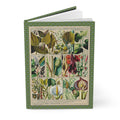
The plate for Classis II. Diandria — the plate reproduced on the cover of this journal — shows a selection of diandrous species arranged with the clarity and elegance that characterizes the best botanical illustration of the period. Each specimen is shown in sufficient detail to allow identification; each is positioned to make the structural argument visible. This is not decoration; it is demonstration.
V. The Art of the Plate
The plates of the Tabulae phytographicae were produced by hand-coloured copper engraving — the same technique that Naumann would use for his bird plates four decades later, and for the same reasons. Copper engraving produced lines of a precision and clarity that no other technique of the period could match; the hand-coloring added the warmth and specificity of color that black-and-white printing could not provide.
The colorists who worked on the Tabulae were working from Gessner's own drawings and from living or dried specimens, applying pigments with fine brushes to each sheet individually. The result was a series of plates in which scientific accuracy and aesthetic refinement are inseparable — in which the beauty of the image is not an addition to the science but an expression of it.
This was the ideal of Enlightenment natural history illustration: that the most accurate representation of a natural object was also, necessarily, the most beautiful, because beauty and truth were understood to be aspects of the same underlying order. To draw a plant correctly was to reveal its structure; to reveal its structure was to participate in the great project of understanding the natural world.
VI. Classification as a Way of Seeing
The Linnaean system did not survive as the primary framework of botanical classification. By the middle of the nineteenth century, it had been largely replaced by natural systems — systems that attempted to group plants according to their overall structural affinities rather than a single diagnostic feature. The Diandria was dissolved; the olive and the lavender and the rosemary were separated into their natural families, where they have remained ever since.
But the Systema Sexuale left a permanent mark on the practice of botany, and on the way educated Europeans thought about the natural world. It taught a generation of naturalists — and, through the illustrated works of Gessner and others, a much wider public — to look at plants with analytical attention, to see the flower not as a decorative object but as a structure with parts that could be counted, named, and compared.
This habit of analytical attention — the willingness to look carefully, to count, to classify, to ask what this thing has in common with that thing — is one of the great intellectual legacies of the Enlightenment. It is the habit that made modern science possible, and it began, in botany, with a man counting stamens in a Swedish garden in the 1730s.
VII. The Persistence of the Plate
Gessner's Tabulae phytographicae were published in a small edition and have never been widely reprinted. The original plates are held in a handful of European libraries and natural history collections; the published volumes are rare enough that most botanists have never seen one in person.
And yet the plates persist — in the collections of those who seek them out, in the digital archives of institutions that have made them available online, and now, in a different form, on the cover of a hardcover journal designed to be used, carried, and written in.
There is something fitting about this. Gessner's plates were always intended to be used — to be looked at, studied, and learned from. They were not made for the archive; they were made for the schoolroom and the study. To put them on the cover of a journal is to return them, in some small way, to the purpose for which they were created: to bring the order and beauty of the plant kingdom into the spaces where people think and write and observe.

Gessner's Diandria plate — hand-coloured copper engraving from the Tabulae phytographicae, published 1795–1804 — on the cover of a hardcover journal. Lavender, olive, rosemary, jasmine: the plants of two stamens, classified by Linnaeus, illustrated by Gessner, and now yours to write beside.
👉 Diandria Botanical Journal — Gessner 1795
References
- Linnaeus, C. (1735). Systema Naturae. Leiden.
- Linnaeus, C. (1753). Species Plantarum. Stockholm.
- Gessner, J. (1795–1804). Tabulae phytographicae. Zurich.
- Stafleu, F.A. (1971). Linnaeus and the Linnaeans. Utrecht.
- Blunt, W. & Stearn, W.T. (1994). The Art of Botanical Illustration. Antique Collectors' Club.
- Morton, A.G. (1981). History of Botanical Science. Academic Press.
- Lack, H.W. (2001). Garden Eden: Masterpieces of Botanical Illustration. Taschen.