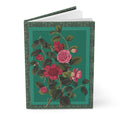
The Flower That Almost Disappeared: Clara Maria Pope, Middlemist’s Red, and the 1819 Camellia Monograph
Share
In the spring of 1804, a nurseryman named John Middlemist stepped off a ship from China carrying something extraordinary: a camellia unlike any seen before in Britain. Deep crimson, fully double, with petals so densely packed they resembled a peony — it was unlike the single-flowered varieties that had trickled into European gardens since the late 18th century. Middlemist sold his plant, it passed through a few hands, and then, quietly, it disappeared from commerce. Today, only two known specimens survive: one at Chiswick House Gardens in London, one in New Zealand. Middlemist’s Red is, by some accounts, the rarest flower in the world outside its native range.
Fifteen years after Middlemist’s ship docked, Samuel Curtis decided to document it.
Samuel Curtis and the Monograph on the Genus Camellia
Samuel Curtis (1779–1860) came from botanical royalty. His uncle, William Curtis, had founded the Botanical Magazine in 1787 — the longest-running botanical periodical in history, still published today. Samuel inherited both the magazine and the family passion for plants, and in 1819 he turned his attention to the camellia: the most fashionable flower of the Regency era, the supreme ornament of the hothouse and conservatory, the flower that aristocratic gardeners competed to cultivate in the most spectacular varieties.
The result was the Monograph on the Genus Camellia — a lavish publication documenting the finest camellia varieties then grown in Britain, with hand-colored aquatint engravings of extraordinary quality. For the illustrations, Curtis chose Clara Maria Pope.
Clara Maria Pope and the Art of the Aquatint
Clara Maria Pope (c.1768–1838) was one of the finest botanical illustrators of the Regency period — and one of the least celebrated. She exhibited at the Royal Academy, contributed to the Botanical Magazine, and produced work of exceptional delicacy and precision. Where many botanical illustrators of the period prioritized scientific accuracy over beauty, Pope achieved both: her flowers are botanically correct and visually ravishing, rendered with a sensitivity to light, texture, and color that makes her aquatints feel almost alive.
For the Camellia Monograph, Pope produced plates of the most prized varieties in Curtis’s collection. The aquatint process — in which a copper plate is etched with acid to create tonal gradations, then hand-colored by skilled colorists — allowed for a richness and subtlety impossible in woodcut or line engraving. Each plate was a collaboration between Pope’s original watercolor, the engraver Weddell’s skilled translation to copper, and the colorists who brought the finished prints to life.
Four Camellias, Four Portraits
The Monograph’s plates document the full range of camellia beauty available to the Regency gardener. The Anemone-flowered Waratah — with its extraordinary double flower of densely packed petals in deep crimson and white, its center a mass of petaloids — was among the most spectacular cultivated varieties of the era. Beside it, Middlemist’s Red: the flower that Middlemist brought from China, that Curtis was determined to preserve in print, that Pope rendered with the precision of a scientist and the sensitivity of an artist who understood she was painting something rare.
Plate I documents the foundational species: the Single White (Camellia japonica ‘Alba Simplex’), pure and luminous with golden stamens; the Single Red, deep and unadorned; and the Sasanqua (Camellia sasanqua), the Japanese species whose smaller, more delicate flowers and fragrance set it apart from the larger japonica varieties. Together, the plates move from the elemental simplicity of the species to the extraordinary complexity of the cultivated varieties — a visual taxonomy of the camellia at the height of its Regency fame.
The Flower That Survived
John Middlemist’s camellia outlasted its introducer, outlasted the nursery trade that briefly carried it, outlasted the Victorian era that forgot it. The specimen at Chiswick House has been growing since at least the 1820s. The one in New Zealand was planted by a settler who brought it from Britain, not knowing — or perhaps not caring — that she was carrying one of the rarest plants in the world.
Clara Maria Pope painted it in 1819. Samuel Curtis published it. And now, more than two centuries later, the flower is still here — documented, preserved, and as beautiful as the day it arrived on Middlemist’s ship.