The Meadow as Pharmacy: Medicinal Plants of Central Europe and the Herbal Tradition
Before the pharmacy, there was the meadow. Across Central Europe — in the fields of Poland, Bohemia, Hungary, and the Alpine foothills — generations of herbalists, apothecaries, and rural healers walked the same landscape each season, reading it as a catalog of remedies. The dandelion that pushed through the path in early spring was not a weed but a medicine: its leaves a bitter tonic for the liver, its roots a diuretic, its flowers a source of the vitamin C that was scarce in winter diets. The yarrow that grew at the field’s edge was a styptic — pressed against a wound, it would slow the bleeding. The wormwood that colonised the dry banks was a digestive bitter, used since antiquity to treat stomach complaints and expel intestinal parasites.

This knowledge was not written down in a single moment. It accumulated over centuries, passed from herbalist to apprentice, from grandmother to granddaughter, tested and refined across generations of practice. What the botanical illustrators of the 19th century did was record it — give it the permanence of print, the authority of scientific classification, the visual precision of the engraver’s art.
The Plants of the Meadow
The wild medicinal plants of Central European meadows are not exotic. They are the plants that grow at the edges of fields, along roadsides, in the margins of forests — the plants that most people walk past without noticing. But each one has a history of use that stretches back centuries.
Taraxacum officinale — the Common Dandelion — was used across Europe as a liver tonic and diuretic. Its Polish name, mniszek lekarski, reflects its medicinal status: lekarski means medicinal. Achillea millefolium, Yarrow, takes its genus name from the myth that Achilles used it to treat the wounds of his soldiers at Troy. Artemisia absinthium, Wormwood, was the basis of absinthe and of countless digestive bitters; its bitter compounds, the absinthins, are among the most intensely bitter substances known. Tussilago farfara, Coltsfoot, was used throughout Europe as a cough remedy — its Latin name means “cough suppressant,” and its leaves were dried and smoked as a treatment for respiratory complaints long before the contradictions of that approach became apparent.
Tanacetum vulgare, Tansy, was used as an insect repellent, a vermifuge, and — in carefully controlled doses — a treatment for fever. Cichorium intybus, Chicory, was roasted as a coffee substitute and used as a digestive tonic. Centaurium erythraea, Centaury, was one of the most widely used bitter tonics in European folk medicine, its name derived from the centaur Chiron, who was said to have discovered its healing properties.
The Zielnik Tradition
In Poland, the illustrated herbal — the zielnik — had a long tradition. The word itself derives from ziele, meaning herb or plant, and the genre combined the practical knowledge of the apothecary with the visual precision of the botanical illustrator. The great zielniks of the 1870s through 1912 — works like August Czarnowski’s Zielnik lekarski czyli Opis 125 ziół używanych w lecznictwie and Maria Arct-Golczewska’s Botanika na przechadzce — were produced at the moment when botanical illustration had reached its technical peak, and when the folk medicine knowledge they documented was beginning to be displaced by modern pharmaceuticals.
The numbered plates of these herbals — each plant labelled in Polish, each specimen rendered with the meticulous detail of scientific illustration — served a dual purpose. They were identification tools for the collector and the apothecary, and they were also a form of cultural preservation: a record of a relationship between people and plants that was already beginning to change.
What Remains
The plants themselves remain. Dandelion still grows in every lawn and field margin. Yarrow still flowers at the edges of paths in late summer. Wormwood still colonises dry banks and roadsides. The meadow pharmacy has not disappeared — it has simply become invisible to most of us, its remedies replaced by synthetic equivalents, its knowledge preserved in the illustrated plates of the zielniks and in the memory of those who still know how to read a landscape.
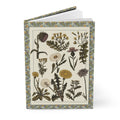
Our Medicinal Herbs Journal carries Tables XV and XVI from the Polish Zielnik tradition — 22 wild healing plants of the Central European meadow, documented with the precision of 19th-century botanical science.
References
- Czarnowski, August. Zielnik lekarski czyli Opis 125 ziół używanych w lecznictwie. c.1912.
- Arct-Golczewska, Maria. Botanika na przechadzce. 1902.
- Grieve, Maud. A Modern Herbal. Jonathan Cape, London, 1931.
- Chevallier, Andrew. The Encyclopedia of Medicinal Plants. Dorling Kindersley, 1996.
- Prance, Ghillean & Mark Nesbitt (eds.). The Cultural History of Plants. Routledge, 2005.