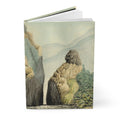
The Landscape and the Legend: Carmelo Fernández, the Comisión Corográfica, and the Myth of Fura and Tena
In 1850, the Comisión Corográfica set out to do something that had never been done before: to map Colombia in its entirety. Not merely its coastlines and rivers, as earlier cartographers had attempted, but its interior — its mountains and valleys, its indigenous communities, its natural resources, its cultures. The expedition was led by Agustín Codazzi, an Italian-Venezuelan geographer of extraordinary ambition, and it employed a team of scientists, writers, and artists to document what they found. Among those artists was Carmelo Fernández, a Venezuelan painter whose watercolors of the Colombian landscape remain among the most beautiful documents of 19th-century Latin American exploration.
The Comisión Corográfica
The Comisión Corográfica (1850–1859) was Colombia’s first comprehensive scientific expedition — a project of national self-knowledge undertaken by a young republic still learning the shape of its own territory. Colombia had achieved independence from Spain in 1819, but three decades later, much of its interior remained unmapped and undocumented by the new nation’s institutions. The Comisión was the answer to that gap.
Codazzi had already produced the first scientific map of Venezuela before coming to Colombia, and he brought to the Comisión the same combination of rigorous methodology and physical endurance that had made that earlier project possible. The expedition traveled through every region of Colombia over nine years, producing maps, botanical collections, ethnographic descriptions, and — crucially — a visual record of the landscape in the watercolors of Fernández and his successors.
The Comisión’s work was not merely cartographic. Its writers — including the novelist and politician Manuel Ancízar, who documented the northern regions — produced accounts of Colombian society and culture that remain primary sources for historians of the period. Its artists produced images of landscapes, peoples, and customs that had never been depicted before. The result was a portrait of Colombia at a particular moment in its history, before industrialization, before the great migrations, before the transformations of the 20th century.
Carmelo Fernández and the Art of Expedition
Carmelo Fernández (1809–1887) was born in Venezuela and trained as a painter before joining the Comisión Corográfica as its principal artist in 1850. His watercolors of the Colombian landscape — produced under field conditions, often in remote locations, always with the dual demands of scientific accuracy and artistic quality — are among the finest examples of 19th-century Latin American expedition art.
Fernández’s technique combined the precision of the scientific illustrator with the sensitivity of a landscape painter. His watercolors document the topography of the Colombian interior with enough accuracy to be useful to cartographers, while simultaneously capturing the quality of light, the texture of vegetation, and the atmosphere of specific places with an artistic intelligence that transcends mere documentation. The Furatena Strait watercolor is characteristic of his best work: a landscape that is simultaneously a geographic record and an evocation of place.
Fura and Tena: The Legend in the Landscape
The Furatena Strait takes its name from one of the most beautiful myths of the Muisca people — the indigenous civilization that inhabited the highlands of central Colombia before the Spanish conquest and whose cultural legacy continues to shape Colombian identity.
According to the legend, Fura and Tena were the first man and woman created by the god Ares — immortal guardians of the emerald mines of the Minero River valley, bound to each other and to the land they protected. Their immortality was conditional on their fidelity: as long as they remained faithful to each other and to Ares, they would never age or die.
The story takes a tragic turn when Fura is seduced by a mortal man named Zarbi. When Tena discovers her infidelity, he dies of grief — and with his death, Fura’s immortality ends. She ages rapidly, weeping over Tena’s body until she too dies. Ares, moved by their tragedy, transforms them into two great rocks that stand facing each other across the Minero River — the Peñas de Fura and Tena, natural formations that are still visible today in the municipality of San Pablo, Boyacá.
The emeralds of the Minero River valley — among the finest in the world, the source of the Colombian emeralds that have been prized since pre-Columbian times — are, in the Muisca tradition, the tears of Fura, crystallized in the rock.
When Carmelo Fernández painted the Furatena Strait in 1850, he was painting a landscape that carried this legend in every stone. The Comisión Corográfica was a project of scientific rationalism, but the landscape it documented was saturated with indigenous meaning that no cartographic survey could fully capture.
What the Watercolor Preserves
The Furatena Strait watercolor is a document of a landscape that has changed significantly since 1850. The Minero River valley has been transformed by mining, agriculture, and the pressures of the 20th century. The emerald mines that gave the region its mythological significance have been worked intensively for centuries, and the landscape Fernández painted is no longer entirely recognizable.
What the watercolor preserves is a moment — a specific quality of light on a specific river on a specific day in 1850, seen through the eyes of an artist who understood that he was documenting something that would not last. The Comisión Corográfica knew that Colombia was changing, and that the landscape and cultures they were documenting were already in the process of transformation. The urgency of that knowledge is present in every watercolor Fernández produced.

Our Carmelo Fernández Furatena Strait Journal carries the 1850 watercolor of the Furatena Strait — the landscape where Muisca legend and Colombian scientific exploration meet, documented by Fernández with the precision and sensitivity of the Comisión Corográfica’s finest artist.
References
- Ancízar, Manuel. Peregrinación de Alpha. Bogotá, 1853.
- Restrepo Forero, Olga. Un imaginario de la nación: Lectura de láminas y descripciones de la Comisión Corográfica. Anuario Colombiano de Historia Social y de la Cultura, 1999.
- Codazzi, Agustín. Geografía física y política de las provincias de la Nueva Granada. Bogotá, 1856.
- Groot, José Manuel. Historia eclesiástica y civil de Nueva Granada. Bogotá, 1869.