The Camellia Craze: How a Chinese Flower Conquered the Victorian Garden
In the winter of 1739, a Jesuit missionary named Georg Joseph Kamel brought a flowering shrub from China to Europe. Kamel — whose Latinised name, Camellus, would eventually be given to the plant by Carl Linnaeus — was not a botanist, and he did not fully understand what he had. But the plant he carried westward, Camellia japonica, would go on to become one of the most coveted flowers in the history of European horticulture: the obsession of Victorian gardeners, the subject of some of the finest botanical illustration of the nineteenth century, and the flower that Alexandre Dumas fils would immortalise in La Dame aux Camélias (1848) as the emblem of a particular kind of tragic, aristocratic beauty.
From China to the Glasshouse
The camellia is native to the mountains of southern China, Japan, and Korea, where it has been cultivated for over a thousand years. In China, the flower was associated with longevity and the new year; in Japan, it was the tsubaki, a flower of deep cultural significance whose falling petals were associated with the samurai ideal of a beautiful death. The plant reached Europe in the early eighteenth century, carried by the traders and missionaries who were beginning to open China to Western commerce, and it arrived at a moment when European aristocracy was in the grip of a passion for all things Chinese — the fashion known as chinoiserie that filled the great houses of England and France with lacquered furniture, blue-and-white porcelain, and exotic plants from the East.
The camellia's first European home was the glasshouse. The plant was believed, incorrectly, to be too tender for the British climate, and it was grown under glass with the same care and expense lavished on pineapples and orchids. This made it, from the beginning, a flower of wealth and status — a plant that required not just money but the infrastructure of a great estate: the heated glasshouse, the head gardener, the army of under-gardeners who maintained the temperature through the winter months.
The Camellia Craze
By the 1820s and 1830s, the camellia had become a full-blown craze. Nurserymen competed to introduce new varieties, each more elaborate than the last — double flowers, striped flowers, flowers with fringed petals, flowers in every shade of red, pink, and white. The vocabulary of camellia cultivation expanded to accommodate the new varieties: the anemone form, the peony form, the formal double, the semi-double, the single. Camellia shows were held at the Royal Horticultural Society, where the finest specimens were displayed and judged with the seriousness of a scientific congress.
The nurseryman Alfred Chandler (1804–1896) was at the centre of this world. His family's nursery at Vauxhall, south London, was one of the leading camellia nurseries in Britain, and Chandler himself was both a skilled cultivator and a gifted botanical artist. In 1831, he published — in collaboration with the botanist William Beattie Booth — Illustrations and Descriptions of the Plants which Compose the Natural Order Camellieae, a landmark work that documented the finest camellia varieties of the day with hand-coloured metal engravings of extraordinary quality.
Chandler's Camellieae
The Camellieae is one of the finest achievements in Victorian botanical illustration. Chandler's hand-coloured engravings achieved an intensity of red and a brilliance of leaf that had rarely been seen in botanical art — the deep, saturated crimson of the camellia bloom rendered with a luminosity that made the printed page seem almost to glow. The plates were produced using metal engraving — a technique that allowed finer detail than the woodcut or lithograph — and then hand-coloured by skilled colourists who worked from Chandler's own paintings, matching the colours of the living flowers with a precision that was itself a form of art.
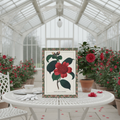
The two varieties that appear on the covers of our journal are among the most celebrated in the publication. Camellia japonica 'Anemoniflora' — the Waratah Camellia, named for its resemblance to the Australian Telopea — was introduced to Europe from China in the early nineteenth century and became one of the most admired varieties of the camellia craze: its distinctive anemone form, with a single row of large outer petals surrounding a dense, mounded centre of narrow petaloid structures transformed from stamens, was unlike anything previously seen in European horticulture. Camellia japonica 'Eximia' — the name means “distinguished” or “exceptional” in Latin — was one of the most prized specimens in Chandler's collection, its blooms rendered with the meticulous precision that made the Camellieae the definitive visual record of Victorian camellia culture.
The Camellia in the Open Garden
The camellia's reputation as a tender plant, requiring the protection of the glasshouse, was overturned in the second half of the nineteenth century, when gardeners discovered that Camellia japonica was in fact perfectly hardy in the British climate — it needed only shelter from the morning sun, which could damage the frozen buds, and protection from the coldest winds. This discovery transformed the camellia from a luxury of the great estate into a flower available to any gardener with a sheltered wall and an acid soil, and it democratised the camellia craze in a way that the glasshouse era never could.
Today, the camellia is one of the most widely grown flowering shrubs in temperate gardens around the world. Thousands of varieties have been developed since Chandler's day, in colours ranging from the purest white to the deepest crimson, in forms from the simplest single to the most elaborate formal double. But the varieties that Chandler documented in 1831 — the Anemoniflora, the Eximia, and the dozens of others that filled his plates — remain among the most beautiful ever grown, and his illustrations remain the finest record of the camellia at the peak of its Victorian moment.
La Dame aux Camélias
The camellia's cultural apotheosis came not in a garden but in a novel. Alexandre Dumas fils published La Dame aux Camélias in 1848, based on his affair with the courtesan Marie Duplessis, who was famous for wearing camellias — white for twenty-five days of the month, red for five. The novel, and the opera it inspired — Verdi's La Traviata (1853) — made the camellia the emblem of a particular kind of beauty: aristocratic, melancholy, and doomed. The flower that had begun as a Chinese import in a Jesuit missionary's luggage had become, in less than a century, one of the great symbols of European Romantic culture.

Our Camellia Journal reproduces two of Chandler's finest plates from the 1831 Camellieae — the Anemoniflora on the front cover and the Eximia on the back — in the hand-coloured engraving technique that made Victorian botanical art the most beautiful scientific illustration ever produced.
References
Blunt, W. & Stearn, W. T. (1994). The Art of Botanical Illustration. Antique Collectors' Club.
Chandler, A. & Booth, W. B. (1831). Illustrations and Descriptions of the Plants which Compose the Natural Order Camellieae. London.
Dumas fils, A. (1848). La Dame aux Camélias. Paris: Alexandre Cadot.
Henderson, A. (2014). The Genus Camellia. Royal Botanic Gardens, Kew.
Seaton, B. (1995). The Language of Flowers: A History. University of Virginia Press.