From Leipzig to Stockholm: Two Centuries of Scientific Illustration and the Frog
In the great age of the European encyclopedia, scientific illustration was not merely a supplement to the text — it was, in many cases, the point. The chromolithographic plates that accompanied the entries of the Brockhaus Konversations-Lexikon, the Larousse, and the Meyers Konversations-Lexikon were objects of visual pleasure as well as scientific instruction: images designed to be looked at, to be admired, to make the natural world comprehensible and beautiful at the same time. When F.A. Brockhaus published the 14th edition of its great encyclopedia in Leipzig between 1894 and 1896, the chromolithographic plates it included were among the finest examples of scientific illustration ever produced for a popular audience. Among them was Frösche und Kröten I — Frogs and Toads I — a plate that brought together nine species of anurans in a composition of extraordinary precision and visual richness.

The Brockhaus Chromolithograph: Science as Visual Art
Chromolithography — the process of printing in multiple colors from a series of lithographic stones — had been developed in the 1830s and 1840s, and by the 1890s it had reached a level of technical refinement that made it capable of reproducing the full chromatic range of a watercolor or oil painting. The Brockhaus chromolithographers worked from drawings produced by specialist scientific illustrators — artists who combined a naturalist's knowledge of their subjects with a printmaker's understanding of the technical possibilities and limitations of the medium. The result was a series of plates that were simultaneously accurate scientific documents and works of art in their own right.
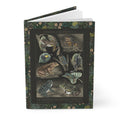
The Frösche und Kröten I plate presents nine numbered anuran species against a dark background that heightens the chromatic richness of the lithographic inks. Among the species depicted are the Peron's tree frog (Litoria peronii), the European fire-bellied toad (Bombina bombina), and the edible frog (Pelophylax esculentus). Each specimen is rendered with the kind of meticulous attention to surface texture, color variation, and anatomical detail that distinguishes the best Victorian scientific illustration from mere diagram. The dark background — a characteristic feature of Brockhaus encyclopedic plates — transforms the composition into something that recalls the natural history cabinet: specimens displayed against darkness, their colors and forms isolated and intensified by the contrast.
The Brockhaus encyclopedia was not a specialist publication. It was designed for the educated general public — the Bildungsbürgertum, the cultivated middle class of the German-speaking world — and its illustrations were designed to be accessible to readers with no specialist scientific training. The chromolithographic plates were, in this sense, a form of popular science: the translation of specialist knowledge into a form that the general public could understand, appreciate, and find beautiful. They were also, in many households, the first encounter with the visual richness of the natural world — the first time a reader had seen a fire-bellied toad or a tree frog rendered with the precision and color of a scientific illustration.
The Swedish Skolplansch: Science for the Classroom
Half a century later and a thousand kilometres to the north, a different tradition of scientific illustration was producing its own masterworks. The Swedish skolplansch — the classroom wall chart — was one of the great achievements of Scandinavian visual pedagogy. Before projectors and digital screens, Swedish science classrooms relied on large-format charts printed on heavy paper, often linen-backed and mounted between wooden rods for hanging. These charts were designed so that entire classes could simultaneously observe the subject of a lesson — a plant, an animal, an anatomical system — without the need for individual specimens or microscopes.
The 1950 frog dissection chart published by Svenska Skolmaterielförlaget Gunnar Saiåtz A-B was a product of this tradition at its most refined. Drawn by specialist scientific illustrators working in the full-color offset lithography that had replaced chromolithography in the mid-twentieth century, the chart was designed to make the internal anatomy of the frog immediately comprehensible to a class of Swedish schoolchildren. Vibrant colors identify the muscular, skeletal, and organ systems with pedagogical clarity; the composition balances scientific accuracy with visual accessibility in a way that reflects the best traditions of Scandinavian design — functional, clear, and quietly beautiful.
The Swedish skolplansch tradition had its roots in the educational reforms of the late nineteenth century, when the Swedish state began investing heavily in the visual equipment of its classrooms. By the mid-twentieth century, the production of educational wall charts had become a sophisticated industry, with specialist publishers commissioning artists and scientists to collaborate on charts that were both pedagogically effective and visually distinguished. The Gunnar Saiåtz frog chart is a late and particularly fine example of this tradition — a document of mid-century Scandinavian educational culture as well as a work of scientific illustration in its own right.
Two Traditions, One Subject
What unites the Brockhaus chromolithograph of 1894 and the Swedish skolplansch of 1950 is not just their shared subject — the frog — but their shared ambition: to make the natural world visible, comprehensible, and beautiful to a non-specialist audience. The Brockhaus illustrators and the Swedish classroom artists were working in different traditions, with different techniques, for different audiences, in different countries and different centuries. But they were engaged in the same fundamental project: the democratisation of scientific knowledge through visual art.
The frog was, in both cases, an ideal subject. It is a creature of extraordinary biological interest — an amphibian that bridges the worlds of water and land, a subject of scientific study since Galvani's experiments with electrical stimulation in the 1780s, a staple of classroom dissection from the nineteenth century to the present day. It is also, in the hands of a skilled scientific illustrator, a creature of considerable visual beauty: the iridescent skin of the tree frog, the vivid red of the fire-bellied toad's underside, the complex internal architecture revealed by dissection — all of these are subjects that reward the kind of careful, attentive illustration that both the Brockhaus chromolithographers and the Swedish skolplansch artists brought to their work.

Our Frog Journal reproduces the Brockhaus Frösche und Kröten I chromolithograph on the front cover and the Swedish skolplansch on the back — two masterworks of European scientific illustration, united on a dramatic black background, spanning over half a century of herpetological pedagogy from Victorian Leipzig to mid-century Stockholm.
References
Brockhaus, F.A. (1894–1896). Brockhaus' Konversations-Lexikon, 14th edition. Leipzig: F.A. Brockhaus.
Nissen, C. (1969). Die zoologische Buchillustration. Stuttgart: Hiersemann.
Sundberg, P. (2001). Svenska skolplanscher. Stockholm: Carlsson Bokförlag.
Twyman, M. (1998). The British Library Guide to Printing: History and Techniques. London: British Library.
Williford, C. (2006). Chromolithography and the Popularisation of Science in the Nineteenth Century. Journal of the History of Collections, 18(2), 211–224.