The Egg as Evidence: The British Museum’s 1901 Catalogue of Birds’ Eggs
There is a particular kind of Victorian ambition that expresses itself in catalogues. Not the modest list, but the total inventory — the systematic attempt to document everything, to bring the entire natural world within the covers of a single work. The Catalogue of the Collection of Birds’ Eggs in the British Museum (Natural History), published from 1901 onwards, is one of the finest examples of this ambition applied to oology: the science of birds’ eggs.

The British Museum’s Oology Collection
By the end of the nineteenth century, the Natural History Museum in London — then formally a department of the British Museum — had assembled one of the most comprehensive collections of birds’ eggs in the world. Specimens arrived from every corner of the British Empire and beyond: from the tropics and the Arctic, from island archipelagos and continental interiors, collected by naturalists, colonial administrators, missionaries, and professional egg collectors who understood that the egg, no less than the bird itself, was a document of natural history.
The collection was not merely a curiosity cabinet. It was a scientific resource — a reference archive against which new specimens could be compared, identifications confirmed, and the extraordinary diversity of avian reproduction systematically studied. Each egg was catalogued with its collector, its locality, its date, and its species identification, creating a record that was simultaneously a work of natural science and a portrait of the Victorian world’s reach into the natural world.
The Authors: Oates, Ogilvie-Grant, and Reid
The Catalogue was the work of three naturalists whose careers embodied the breadth of late Victorian ornithology.
Eugene William Oates (1845–1911) was a civil servant and naturalist who spent much of his career in Burma and India, where he assembled an extraordinary knowledge of South and Southeast Asian birds. His Fauna of British India: Birds (1889–1890) remains a landmark of colonial natural history, and his work on the British Museum’s egg collection brought the same systematic rigour to oology that he had applied to ornithology more broadly.
William Robert Ogilvie-Grant (1863–1924) was a staff member of the Natural History Museum’s bird department for over three decades, one of the most productive ornithologists of his generation. He described dozens of new species, led expeditions to the Canary Islands and the Azores, and contributed to the Catalogue the deep institutional knowledge of a man who had spent his working life among the museum’s collections.
Philip Savile Grey Reid (1845–1902) was a collector and naturalist whose contributions to the museum’s holdings were substantial. His work on the Catalogue was cut short by his death in 1902, but his expertise in egg identification and his meticulous approach to documentation shaped the project’s scientific standards.
Together, the three authors brought to the Catalogue a combination of field experience, institutional authority, and taxonomic precision that made it the definitive reference work on birds’ eggs for a generation of ornithologists.
The Lithographic Plates
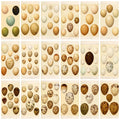
The illustrations that accompany the Catalogue are among the finest oology plates ever produced. Rendered in lithography — the dominant medium of scientific illustration in the nineteenth century — they document the eggs of European and global bird species with a precision and beauty that transcends mere scientific record.
Each plate presents a selection of eggs at natural scale, their colors and patterns rendered with the accuracy of a taxonomic instrument. The range is extraordinary: from the large and boldly marked to the tiny and delicately spotted, from the pure white of cavity-nesting species to the densely patterned camouflage of ground-nesters, from the smooth and glossy to the rough and granular. The plates are simultaneously a scientific catalogue and a visual celebration of the diversity of avian reproduction — a demonstration that the egg, like the bird, is a solution to the problem of survival, shaped by millions of years of evolutionary pressure into forms of extraordinary variety and beauty.
Oology as Science and Art
The study of birds’ eggs occupied a central place in Victorian natural history for reasons that went beyond mere collecting. The egg was understood as a key to the bird’s identity — its color and pattern a product of the same evolutionary forces that shaped plumage, song, and behavior. The study of egg mimicry, of clutch size, of incubation period, of nest architecture — all of these were understood as windows into the biology and ecology of the bird itself.
The British Museum’s Catalogue brought this science to its highest Victorian expression: a systematic, illustrated inventory of the world’s birds’ eggs, documented with the authority of the greatest natural history institution in the world, illustrated with plates of exceptional beauty, and made available to the scientific community as a permanent reference work.
A Collection for Today
The 18 plates in this digital collection represent the visual heart of the Catalogue — a selection of lithographic illustrations that document the extraordinary diversity of European bird eggs with the precision and aesthetic sensibility of the Victorian scientific tradition. They are documents of a moment when natural history was both a science and an art, when the careful observation of the natural world was understood as one of the highest expressions of human curiosity.
Printed and framed, they bring that tradition into the present — a reminder that the egg, the smallest and most fragile of natural objects, carries within it the entire history of a species.