Brehms Tierleben: The Encyclopedia That Taught Europe to See Animals
In the middle of the nineteenth century, most Europeans had never seen a lion, an elephant, or a chimpanzee. They had read descriptions of these animals in travel accounts and natural history texts, and they had seen crude woodcut illustrations in popular magazines, but they had no reliable sense of what these creatures actually looked like — how they moved, how they lived, what their relationship was to the world around them. Alfred Edmund Brehm set out to change this, and he succeeded so completely that his name became, in the German-speaking world, synonymous with the knowledge of animals.
The Man Who Knew Animals
Alfred Edmund Brehm was born in 1829 in Renthendorf, Thuringia, the son of a Lutheran pastor who was also an amateur ornithologist of considerable distinction. He grew up surrounded by birds — his father's collections, his father's observations, his father's passion for the natural world — and he inherited both the passion and the method. At the age of eighteen, he accompanied a friend's father on an expedition to Egypt and the Sudan, where he spent six years travelling through northeastern Africa, observing and collecting animals with an intensity and devotion that would define the rest of his life.
He returned to Germany in 1852 with notebooks full of observations, a collection of specimens, and a conviction that the natural history writing of his day was inadequate — too dry, too technical, too focused on classification and taxonomy at the expense of the living animal in its living environment. He wanted to write about animals as they actually were: their behaviour, their social lives, their relationships with other species, their individual characters. He wanted, in short, to write natural history that read like literature.
Brehms Tierleben
The first edition of Brehms Tierleben — Illustrirtes Thierleben in its original title — was published between 1863 and 1869 in six volumes, covering mammals, birds, reptiles, amphibians, fish, and invertebrates. It was an immediate and enormous success. Brehm's prose was vivid, accessible, and full of the kind of specific, observed detail that made the animals he described feel real and present — not specimens in a cabinet but living creatures with personalities, habits, and histories. The book was read by scientists and schoolchildren, by aristocrats and factory workers, by anyone who was curious about the natural world and wanted to understand it.
The second edition, published between 1876 and 1879 in ten volumes, was the one that established Brehms Tierleben as a cultural monument. It was expanded, revised, and — crucially — illustrated with chromolithographic plates of a quality that had never before been achieved in a popular natural history publication. The plates were produced by some of the finest scientific illustrators of the day, including the entomologist Ernst Ludwig Taschenberg, who contributed the insect volumes, and the animal painter Friedrich Kuhnert, whose chromolithographs of mammals and birds set a new standard for zoological illustration.
The Art of Chromolithography
Chromolithography — the process of printing in multiple colours using a series of lithographic stones, one for each colour — was developed in the 1830s and reached its technical peak in the 1870s and 1880s, precisely the period when Brehms Tierleben was being produced. The process allowed for a richness and subtlety of colour that earlier printing techniques could not match: the graduated tones of a bird's plumage, the iridescent sheen of an insect's wing, the complex greens and browns of a forest floor could all be rendered with a fidelity that brought the illustration close to the quality of a watercolour painting.
The chromolithographic plates in Brehms Tierleben were produced using between eight and fifteen separate colour passes, each requiring precise registration to ensure that the colours aligned correctly. The process was expensive, time-consuming, and technically demanding, and the results were extraordinary: images of such scientific accuracy and visual beauty that they functioned simultaneously as research tools and as works of art. Many of the plates were framed and hung on walls — in schools, in doctors' waiting rooms, in the homes of the educated middle class — where they served as windows onto a natural world that most people would never directly encounter.
The Bee Plates
Volume 9 of the second edition — Die Insekten, Tausendfüssler und Spinnen (The Insects, Centipedes, and Spiders), published in 1877 with text by Ernst Ludwig Taschenberg — is among the finest volumes in the series. Taschenberg (1816–1902) was one of the leading entomologists of his day, a professor at the University of Halle whose research on insect taxonomy and behaviour was widely respected, and his text combined scientific rigour with the accessible, vivid style that Brehm had established as the house manner of Tierleben.
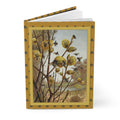
The honey bee plates in Volume 9 are among the most celebrated in the entire series. Plate 07, “Frühleben der Insektenwelt” (Spring in the Insect World), depicts honey bees and other insects extracting nectar from pussy willow branches (Salix) in a luminous spring landscape — a composition of such scientific precision and visual beauty that it captures both the entomological reality of the hive's spring awakening and the aesthetic pleasure of the natural world at its most vivid. The companion plate, “Bienentraube, Schwarm” (Bee Cluster, Swarm), shows a dense living cluster of bees hanging from a tree branch, with a man and a woman in period clothing observing the swarm and traditional beehives visible in the background — a scene that unites the scientific phenomenon of swarming with the intimate relationship between Victorian rural life and the keeping of bees.
A Legacy in Every Home
By the end of the nineteenth century, Brehms Tierleben had sold hundreds of thousands of copies and had been translated into multiple languages. It was the natural history book that every educated European household owned — the reference work that children consulted when they wanted to know about animals, the book that shaped the way a generation understood the natural world. Its influence on popular natural history writing was enormous: the tradition of accessible, vivid, behaviourally focused natural history that runs from Brehm through to David Attenborough owes a direct debt to the approach that Brehm pioneered.
Brehm himself died in 1884, the year the final volume of the second edition was published. He did not live to see the third edition, or the fourth, or the many subsequent revisions that kept Tierleben in print well into the twentieth century. But the chromolithographic plates of the second edition — produced at the peak of the art form, by some of the finest scientific illustrators of the century — remain the definitive visual expression of his vision: a world of animals seen with scientific precision and rendered with the devotion of someone who genuinely believed that the natural world was the most extraordinary thing there was.

Our Bees in Spring Journal reproduces two of the finest bee plates from Brehms Tierleben Volume 9 (1877) — the spring honey bee chromolithograph on the front cover and the bee swarm on the back — in the multi-colour printing technique that defined Victorian natural history illustration at its peak.
References
Brehm, A. E. & Taschenberg, E. L. (1877). Brehms Tierleben, Vol. 9: Die Insekten, Tausendfüssler und Spinnen. Bibliographisches Institut, Leipzig.
Engel, M. S. (2015). Innumerable Insects: The Story of the Most Diverse and Myriad Animals on Earth. Sterling Publishing.
Nissen, C. (1969). Die zoologische Buchillustration. Anton Hiersemann.
Ogilvie, B. W. (2006). The Science of Describing: Natural History in Renaissance Europe. University of Chicago Press.
Schmidt, B. (2004). Alfred Brehm: Leben und Werk. Weimarer Verlagsgesellschaft.