The Botanist’s Eye: Flora’s Dress, Reduöt’s Roses, and Five Centuries of Floral Art
Share
In 1482, Sandro Botticelli painted a dress.
It was, of course, much more than a dress. La Primavera — the most celebrated painting of the Florentine quattrocento, now hanging in the Uffizi Gallery — is a complex Neoplatonic allegory of spring, love, and the generative power of beauty. But at its centre stands Flora, the goddess of spring, and what she is wearing has fascinated botanists, art historians, and lovers of beauty for over five centuries.
The Dress That Botanists Cannot Stop Counting
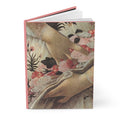
Flora’s gown is embroidered with flowers. This much is obvious. What is less obvious — and what makes Botticelli’s achievement so extraordinary — is that the flowers are real. Not decorative approximations, not generic blossoms, but identifiable species rendered with the precision of a botanical illustration.
Botanists who have studied the painting have identified over 40 distinct flower species in Flora’s dress and in the meadow at her feet: roses, cornflowers, anemones, daisies, violets, irises, and many more, each rendered with enough botanical accuracy to be identified by genus and sometimes by species. The roses she scatters from her hands — the central gesture of the painting, the act that defines her role as the goddess of spring — are identifiable as Rosa canina, the dog rose, the wild rose of the European hedgerow.
This was not accidental. Botticelli was working in a Florence where the boundary between art and science was not yet fixed — where the same Neoplatonic philosophy that inspired his allegories also inspired the botanical gardens of the Medici, where the study of plants was understood as a form of devotion to the divine order of nature. Flora’s dress is not just beautiful. It is a scientific document.
Reduöt and the Science of the Rose
Three centuries later, in the Paris of the Napoleonic era, Pierre-Joseph Reduöt was doing something similar — and doing it with a precision that earned him the title “the Raphael of Flowers.”
Reduöt (1759–1840) was the most celebrated botanical illustrator of his age, official court painter to Marie Antoinette and later to the Empress Joséphine, whose rose garden at Malmaison was the most important collection of roses in Europe. His Les Roses (1817–1824) — three volumes documenting 169 rose varieties in stipple-engraved colour plates — is the definitive scientific and artistic portrait of the rose, a work that combines the rigour of a botanical monograph with the beauty of a Renaissance masterpiece.
The stipple-engraving technique that Reduöt perfected — building up tone through thousands of tiny dots rather than lines — allowed him to capture the translucency of rose petals with a delicacy that no previous botanical illustrator had achieved. His roses glow from the page. The Pompon de Bourgogne, the Rose Parvula, the Rose Paquerette — small roses, modest roses, roses that a less attentive artist might have dismissed as unworthy of attention — receive from Reduöt the same loving precision that Botticelli gave to the flowers of Flora’s dress.
Five Centuries, One Rose
What connects Botticelli and Reduöt is not just the rose, but the conviction that the rose deserves to be looked at — really looked at, with the full attention of a trained eye and a skilled hand. Botticelli embedded his roses in an allegory of spring and divine beauty; Reduöt isolated his roses against a plain background and documented them with scientific precision. But both understood that the rose is not just a flower. It is an argument about beauty — about the relationship between the natural world and the human capacity to perceive and represent it.
Flora’s scattered roses and Reduöt’s painted roses are, in the end, the same roses: the eternal rose of the Western imagination, blooming again and again across five centuries without ever losing its power to move us.