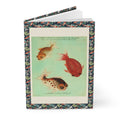
Billardon de Sauvigny and the First European Goldfish Monograph
In 1780, a French writer and naturalist named Edme-Louis Billardon de Sauvigny published a book unlike any that had appeared in Europe before. Its title was Histoire naturelle des dorades de la Chine — the Natural History of the Gilded Fish of China — and it was the first European monograph dedicated exclusively to the ornamental goldfish that Chinese breeders had been developing for more than a thousand years. Illustrated with 48 hand-colored plates engraved by François-Nicolas Martinet, the court engraver who had already produced the celebrated plates for Buffon's Histoire naturelle des oiseaux, it was simultaneously a work of science, a work of art, and a document of one of the most remarkable cross-cultural exchanges in the history of natural history.

The Goldfish in China: A Thousand Years of Breeding
The goldfish — Carassius auratus — is a domesticated form of the Prussian carp, native to East Asia, that was first selectively bred in China during the Tang dynasty (618–907 CE). The earliest records of ornamental goldfish keeping date from the Song dynasty (960–1279), when the fish were kept in ponds and ceramic vessels in the gardens of the imperial court and the homes of the wealthy. Over the following centuries, Chinese breeders developed an extraordinary range of varieties through selective breeding — fish with telescoping eyes, double tails, bubble heads, and bodies of every color from white to black, from gold to deep red — that had no parallel in the natural world and that represented one of the most sophisticated achievements of pre-modern animal husbandry.
The Dragon Eyes goldfish — the Long-Tsing-Yu documented in Plate 22 of Billardon de Sauvigny's monograph — were among the most prized of these varieties. Their prominent, protruding eyes — the result of centuries of selective breeding for a trait that would have been a fatal disadvantage in the wild — gave them a dramatic, otherworldly appearance that made them objects of fascination in the imperial gardens and, eventually, in the salons of 18th-century Paris.
The Arrival of the Goldfish in Europe
Goldfish first reached Europe in the late 17th century, brought by Portuguese and Dutch traders who had established commercial relations with China. They arrived as curiosities — living jewels, exotic and fragile, that required careful management to survive the long sea voyage and the unfamiliar climate of northern Europe. By the mid-18th century, they had become fashionable ornaments in the gardens and drawing rooms of the European aristocracy: Louis XV kept goldfish at Versailles, and the Duchess of Portland — one of the great natural history collectors of the age — maintained a collection of Chinese ornamental fish at Bulstrode Park.
But despite their growing popularity, goldfish remained poorly understood by European naturalists. The standard taxonomic references — Linnaeus's Systema Naturae, Buffon's Histoire naturelle — gave them only cursory treatment, and the extraordinary diversity of Chinese ornamental varieties was almost entirely unknown in the West. It was this gap that Billardon de Sauvigny set out to fill.
Billardon de Sauvigny and the Making of the Monograph
Edme-Louis Billardon de Sauvigny (1736–1812) was a man of letters rather than a professional naturalist — a playwright, poet, and journalist who had made his reputation in the literary circles of pre-Revolutionary Paris. His interest in goldfish appears to have been sparked by access to a collection of Chinese paintings and drawings sent to the French court, which documented the varieties of ornamental fish cultivated in Chinese imperial gardens with a visual precision that no European observer had achieved.
Working from these Chinese sources — which he acknowledged explicitly in his text, noting that his knowledge of the fish was based on "paintings and notes sent from China" — Billardon de Sauvigny compiled descriptions of 88 varieties of ornamental goldfish, organized by their physical characteristics and named in both French and Chinese. The French names he chose — Le Rouillé (The Rusty), Le Cerise (The Cherry), Le Léopard (The Leopard), Le Souci (The Marigold), La Capucine (The Nasturtium) — reflected the Enlightenment taste for descriptive, evocative nomenclature that connected the natural world to the familiar world of flowers, colors, and textures.
François-Nicolas Martinet and the Art of the Plate
The visual achievement of Histoire naturelle des dorades de la Chine was inseparable from the work of François-Nicolas Martinet (c. 1731–c. 1800), the engraver and naturalist who had already established his reputation with the 1,008 hand-colored plates he produced for Buffon's Histoire naturelle des oiseaux (1770–1786) — one of the most ambitious natural history illustration projects of the 18th century.
Martinet's task with the goldfish monograph was unusual: he was working not from living specimens or field sketches, as he had with the birds, but from Chinese paintings — images produced in a visual tradition entirely different from the European naturalist illustration he had mastered. The challenge was to translate the flat, decorative aesthetic of Chinese fish painting into the tonal, three-dimensional style of European copper-plate engraving, while preserving the accuracy of the original observations. The result — 48 plates of extraordinary delicacy, hand-colored to capture the iridescent quality of the fish's scales and the vibrant hues of their bodies — was a triumph of cross-cultural visual translation that remains one of the most beautiful achievements of 18th-century natural history illustration.
The Monograph as Cultural Document
Histoire naturelle des dorades de la Chine was more than a scientific reference. It was a document of the Enlightenment's fascination with China — that complex mixture of admiration, curiosity, and misunderstanding that historians have called chinoiserie — and of the ways in which natural history served as a medium for cross-cultural exchange in the 18th century. Billardon de Sauvigny's acknowledgment of his Chinese sources, his preservation of Chinese names alongside French ones, and his explicit recognition that the breeding achievements he was documenting were the product of Chinese skill and knowledge rather than European science, gave his monograph a cross-cultural generosity unusual for its time.
The book was also a commercial object — produced for the luxury market of pre-Revolutionary Paris, for the aristocrats and wealthy bourgeois who kept goldfish in their garden ponds and drawing-room bowls and who wanted a beautiful, authoritative reference to the varieties they admired. In this sense, it belonged to the tradition of the great illustrated natural history books of the 18th century — works like Ehret's Plantae et Papiliones Rariores, Audubon's Birds of America, and Gould's bird monographs — that united scientific ambition with aesthetic achievement and that remain among the most beautiful books ever produced.

If the gilded fish of China inspire you, our Goldfish Journal — Martinet 1780 Dragon Eyes Engraving brings Plates 22 and its companion to the cover of a hardcover journal, celebrating the moment Chinese ornamental fish first entered European scientific consciousness.
References
- Billardon de Sauvigny, E.-L. Histoire naturelle des dorades de la Chine. Paris, 1780.
- Smartt, J. & Bundell, J. B. Goldfish Varieties and Genetics: A Handbook for Breeders. Blackwell Science, 1996.
- Hervey, G. F. & Hems, J. The Goldfish. Faber & Faber, 1948.
- Impey, O. Chinoiserie: The Impact of Oriental Styles on Western Art and Decoration. Oxford University Press, 1977.
- Farber, P. L. Finding Order in Nature: The Naturalist Tradition from Linnaeus to E. O. Wilson. Johns Hopkins University Press, 2000.