The Room as Portrait: Austrian Biedermeier Watercolours and the Art of the Zimmerbilder
Share
There is a particular kind of painting that flourished in Central Europe between 1815 and 1848 — a kind of painting so modest in its ambitions, so intimate in its subject matter, that it has never quite found its place in the grand narratives of art history. It is called the Zimmerbilder, or chamber picture: a watercolour portrait of a domestic room, rendered with the same loving precision that earlier centuries had reserved for faces and landscapes.
The rooms depicted in these paintings are not grand. They are the rooms of the middle class — the Bürgertum that emerged in the German-speaking world after the Napoleonic Wars, a class that had neither the aristocratic grandeur of the old regime nor the industrial wealth of the coming century, but that had developed, in the space between, a distinctive aesthetic of its own: functional, elegant, restrained, and deeply attentive to the beauty of everyday things.
The Biedermeier Aesthetic
The word Biedermeier was originally a satirical invention — a composite name for the complacent, philistine German bourgeois, coined by the poet Ludwig Eichrodt in the 1850s. But the aesthetic it came to describe was anything but philistine. Biedermeier furniture — light-coloured wood, clean lines, functional forms — was among the most sophisticated design produced in 19th-century Europe. Biedermeier interiors — floral wallpaper, curtained alcoves, writing desks arranged for use rather than display — were spaces designed for living, for reading, for correspondence, for the quiet pleasures of a cultivated domestic life.
The Zimmerbilder artists documented these spaces with extraordinary care. They were, for the most part, anonymous — professional watercolourists who worked on commission, producing records of rooms that their owners wished to preserve. The paintings were not intended as art in the grand sense; they were intended as documents, as memories, as portraits of the spaces in which a life had been lived.
The Cooper Hewitt and the Wien Museum
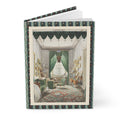
The two watercolours that appear on this journal are among the finest surviving examples of the Zimmerbilder tradition. The 1853 curtained bed alcove — now in the Cooper Hewitt, Smithsonian Design Museum, Thaw Collection, New York — depicts a bedroom with green drapery, light-coloured Biedermeier furniture, and floral wallpaper: the hallmarks of the style, rendered in watercolour and gouache with gum arabic with a precision that allows the viewer to count the flowers on the wallpaper and trace the grain of the wood.
The 1840 Schreibkabinett — now in the Wien Museum, Vienna — presents the intellectual heart of the Biedermeier home: the writing room, with its desk and chairs and the quiet order of a space designed for thought and correspondence. It is a room that carries, across nearly two centuries, the sense of a life being lived with care and intention.
Together, they are a portrait of a world: the bedroom and the study, the private and the intellectual, the intimate domesticity of Central European middle-class culture at the height of the Biedermeier period.