Benjamin Heyne and the Plutonist Revolution: Mapping the Earth's Hidden Architecture
In the closing decades of the eighteenth century, a quiet revolution was transforming the way educated Europeans understood the ground beneath their feet. For centuries, the dominant theory of the Earth's history had been Neptunism — the idea, associated above all with the German geologist Abraham Gottlob Werner, that all rocks had been deposited from a primordial ocean that once covered the entire surface of the globe. Granite, basalt, limestone, sandstone — all were, in Werner's system, sedimentary in origin, laid down in successive layers as the universal ocean gradually receded. It was a theory of extraordinary elegance and explanatory power, and it commanded the assent of virtually every geologist in Europe in the 1780s and 1790s.
But the Neptunist consensus was about to be challenged by a rival theory of equal elegance and far greater explanatory power: Plutonism, the idea that the Earth's internal heat — not the primordial ocean — was the engine behind the formation of rocks, the uplift of mountains, and the eruption of volcanoes. The Plutonist revolution, associated above all with the Scottish geologist James Hutton and his Theory of the Earth (1788), would transform geology from a descriptive science into a dynamic theory of the Earth's interior, and it would produce, in the process, some of the most visually arresting scientific illustrations of the early nineteenth century — among them the geological cross-section published in the Traité de Botanique Générale, associated with the work of Benjamin Heyne.
James Hutton and the Theory of the Earth
James Hutton (1726–1797) was a Scottish physician, farmer, and natural philosopher who spent decades observing the rocks of Scotland and arriving at a conclusion that would overturn the Neptunist consensus: that the Earth was not a static deposit of sedimentary layers but a dynamic system, driven by internal heat, in which rocks were continuously formed, uplifted, eroded, and reformed in an endless cycle. His key insight — derived from his observations of granite intrusions cutting through sedimentary strata at Siccar Point on the Scottish coast — was that granite was not a primordial sedimentary rock but an igneous one, formed by the cooling of molten material that had been injected into the surrounding strata from below by the Earth's internal heat.
Hutton's Theory of the Earth, first presented to the Royal Society of Edinburgh in 1785 and published in expanded form in 1795, was a work of extraordinary intellectual ambition: a complete theory of the Earth's history, based on the principle that the present is the key to the past — that the same processes of heat, pressure, erosion, and deposition that can be observed operating today have been operating throughout geological time, producing the rocks and landscapes of the present world. It was also, in its original form, almost unreadably dense, and it was left to Hutton's friend and disciple John Playfair to present his ideas in the accessible and elegant form of Illustrations of the Huttonian Theory of the Earth (1802), which became the standard introduction to Plutonist geology for the next generation of naturalists.
Benjamin Heyne: Botanist, Naturalist, Geologist
Benjamin Heyne (1770–1819) was born in Weissenfels in Saxony and trained as a missionary at the Francke Foundations in Halle, the great centre of German Pietist education and scientific inquiry. Sent to India by the Basel Mission in 1792, he spent the next two decades in the service of the East India Company, working as a botanist and naturalist across the Indian subcontinent — in Madras, in Mysore, in the Deccan — and accumulating an extraordinary collection of botanical and geological observations that he would eventually publish in his Tracts, Historical and Statistical, on India (1814).
Heyne was a naturalist of the old school: a man for whom botany, geology, mineralogy, and natural history were not separate disciplines but aspects of a single inquiry into the structure and history of the natural world. His geological observations in India — his descriptions of the Deccan Traps, the vast basalt formations of central India that are now understood to be the product of one of the largest volcanic events in Earth's history — were among the first systematic geological observations made in the subcontinent, and they contributed to the growing body of evidence that was undermining the Neptunist consensus and supporting the Plutonist alternative.
The Geological Cross-Section and the Traité de Botanique Générale
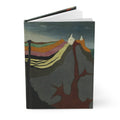
The geological cross-section published in the Traité de Botanique Générale — produced in Paris between approximately 1814 and 1820, with later lithographic editions extending into the 1860s — is one of the most visually striking scientific illustrations of the early nineteenth century. Conceived to illustrate the Plutonist theory of the Earth's interior, it presents a panoramic cross-section of the globe that reads today with the confidence of modern abstract art: an active volcano on the left, its column of fire and smoke fed by a vivid red vein of magma; sedimentary strata in yellow, orange, black, and grey curving dramatically under tectonic pressure at the centre, pierced by turquoise and black igneous intrusions; snow-capped peaks crowning a vast mass of igneous rock on the right, its root-like veins spreading deep into the Earth's interior.
The illustration is a document of a moment of scientific transition: the Plutonist theory was still contested in 1814, and the cross-section was conceived as a visual argument for the revolutionary idea that the Earth's internal heat — not the primordial ocean — was the engine of geological change. The bold colour fields, the dramatic volcanic forms, and the geometric precision of the strata are all in the service of this argument: they make visible, in a single image, the dynamic, heat-driven Earth that Hutton had described in words and that Heyne and his contemporaries were documenting in the field.
Scientific Illustration as Art
What makes the Heyne cross-section remarkable, beyond its scientific content, is its visual quality. The hand-illuminated engraving technique — the precise engraved lines filled with flat colour fields of extraordinary chromatic intensity — produces an image that is simultaneously a scientific diagram and a work of art. The red of the magma, the turquoise of the igneous intrusions, the warm yellows and oranges of the sedimentary strata, and the cool greys of the volcanic smoke create a palette that feels strikingly contemporary — closer to the colour field painting of the twentieth century than to the muted tones of most early nineteenth-century scientific illustration.
This visual quality was not accidental. The great scientific illustrators of the early nineteenth century — working in Paris, London, and Edinburgh at a moment when the natural sciences were expanding with extraordinary rapidity and the demand for illustrated scientific publications was at its height — understood that the visual impact of an illustration was inseparable from its scientific effectiveness. An image that arrested the eye, that made the invisible visible with clarity and beauty, was not merely aesthetically pleasing: it was scientifically persuasive, capable of communicating the structure of the Earth's interior to readers who had never seen a volcano or a geological section in the field.
If the fire of geological discovery inspires you, our Geological Journal — Heyne 1814 Plutonist Earth Strata brings the cross-section to the cover of a hardcover journal.
References
- Hutton, J. Theory of the Earth. Edinburgh, 1795.
- Playfair, J. Illustrations of the Huttonian Theory of the Earth. Edinburgh, 1802.
- Heyne, B. Tracts, Historical and Statistical, on India. London, 1814.
- Rudwick, M. J. S. Bursting the Limits of Time: The Reconstruction of Geohistory in the Age of Revolution. University of Chicago Press, 2005.
- Oldroyd, D. R. Thinking About the Earth: A History of Ideas in Geology. Harvard University Press, 1996.