Audubon and The Birds of America: The Most Ambitious Work in the History of Natural History Illustration
In the spring of 1826, a French-American painter and naturalist named John James Audubon sailed from New Orleans to Liverpool carrying a portfolio of watercolors unlike anything that had been seen in Europe before. The watercolors depicted the birds of North America — not as the stiff, static specimens that had characterized ornithological illustration since the 17th century, but as living creatures, rendered at life size, in poses of extraordinary dynamism and naturalistic accuracy: a golden eagle tearing at its prey, a pair of mockingbirds defending their nest against a rattlesnake, a great blue heron standing in the shallows with a fish in its bill. Audubon had spent more than a decade traveling the American wilderness to make these images, and he had come to Europe to find a publisher capable of doing them justice. What he found, in the Edinburgh engraver William Home Lizars and then in the London master Robert Havell Jr., was the technical partnership that would produce one of the most extraordinary books in the history of publishing: The Birds of America (1827–1838).
The Making of a Masterpiece
The ambition of The Birds of America was staggering. Audubon had decided from the outset that his birds would be reproduced at life size — a decision that determined the format of the publication and made it unlike anything that had been attempted before. To accommodate the life-size image of the largest birds — the whooping crane, the great blue heron, the American flamingo — the plates had to be printed on paper measuring 39.5 by 26.5 inches: the Double Elephant Folio, the largest paper size commercially available in early 19th-century Britain. The result was a publication of extraordinary physical presence — a book so large that it required a special stand to hold it, and so expensive that only the wealthiest institutions and individuals could afford to subscribe.
The production process was equally extraordinary. Each of the 435 plates began as a watercolor by Audubon, painted from specimens that he had collected, measured, and posed on wire armatures to capture the natural postures of living birds. The watercolors were then transferred to copper plates by the engravers of the Havell workshop, who reproduced Audubon's images in aquatint — a printmaking technique that could capture the tonal gradations and textural subtleties of watercolor with a fidelity that no other engraving method could match. The printed plates were then hand-colored by a team of colorists working under Havell's supervision, who applied watercolor washes to each print individually, matching the colors of Audubon's originals with a consistency and accuracy that, across an edition of approximately 200 complete sets, represented one of the most remarkable feats of coordinated craft production in the history of publishing.
Robert Havell and the Art of Aquatint
The technical achievement of The Birds of America was inseparable from the skill of Robert Havell Jr. (1793–1878), the London engraver who took over the production of the plates in 1827 after the original engraver, William Home Lizars, encountered difficulties with his colorists. Havell was the son and grandson of engravers, trained in the aquatint tradition that had been developed in England in the late 18th century and that had become, by the 1820s, the dominant medium for the reproduction of watercolor originals in the luxury publishing trade.
Aquatint — a variant of etching in which the copper plate is coated with a porous ground of resin dust that, when bitten by acid, produces a granular texture capable of holding ink in a way that mimics the wash effects of watercolor — was ideally suited to the reproduction of Audubon's images. The technique allowed Havell to capture not only the outlines and details of Audubon's birds but the atmospheric qualities of his backgrounds — the soft gradations of sky and water, the textural complexity of foliage and rock — that gave the plates their extraordinary sense of place and presence. The hand-coloring that completed each plate added the final dimension: the coral pink of the flamingo's plumage, the iridescent green of the hummingbird's gorget, the deep black of the eagle's wing — colors applied with a precision and consistency that, across hundreds of prints, represented a triumph of craft organization as much as individual skill.
The American Flamingo: Plate 431
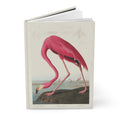
Among the 435 plates of The Birds of America, Plate 431 — the American Flamingo (Phoenicopterus ruber) — holds a special place. The flamingo is the largest bird in the publication, and its extraordinary form — the long neck bent in its characteristic S-curve, the coral plumage deepening to rose at the wing coverts and black at the flight feathers, the distinctive pink-and-black bill adapted for filter-feeding — presented Audubon with one of his greatest compositional challenges and produced one of his most celebrated solutions.
Audubon observed the American Flamingo in the Florida Keys, where small populations still existed in the early 19th century before hunting and habitat destruction reduced them to the vanishing point. His portrait captures the bird in its natural habitat — wading in shallow water, neck bent in the feeding posture that is the species' most characteristic behavior — with the combination of scientific accuracy and artistic sensitivity that defines his best work. The life-size format of the Double Elephant Folio allowed him to render the flamingo at its full height of nearly four feet, giving the plate a physical presence that no smaller reproduction could replicate.
The Legacy of The Birds of America
The publication of The Birds of America was completed in 1838, after eleven years of production and the engraving of 435 plates. Approximately 200 complete sets were produced — the exact number is uncertain, since the publication was issued in parts over more than a decade and not all subscribers received all parts. Today, complete sets are among the most valuable books in the world: a complete copy sold at Christie's in 2010 for $11.5 million, making it the most expensive printed book ever sold at auction at that time.
But the legacy of The Birds of America extends far beyond its commercial value. Audubon's plates transformed the visual language of ornithological illustration, establishing a standard of life-size, dynamically posed, naturalistically accurate bird portraiture that influenced every subsequent generation of wildlife artists. The Audubon Society — founded in 1905 and named in his honor — remains one of the most important conservation organizations in the United States, a testament to the enduring power of his vision of the American avifauna as something worth knowing, celebrating, and protecting.
If Audubon's vision of the American flamingo inspires you, our Flamingo Journal — Audubon Plate 431 Birds of America brings Plate 431 to the cover of a hardcover journal.
References
- Audubon, J. J. The Birds of America. Robert Havell, London, 1827–1838.
- Rhodes, R. John James Audubon: The Making of an American. Knopf, 2004.
- Souder, W. Under a Wild Sky: John James Audubon and the Making of The Birds of America. North Point Press, 2004.
- Blaugrund, A. & Stebbins, T. E. (eds.) John James Audubon: The Watercolors for The Birds of America. Villard Books, 1993.
- Fries, W. H. The Double Elephant Folio: The Story of Audubon's Birds of America. American Library Association, 1973.