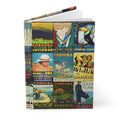
The Golden Age of Argentine Travel Posters: Tourism, Railways and Graphic Art in the 1930s
In the 1930s, Argentina was a country in motion. The great railway networks that had been built by British capital in the late nineteenth century had matured into a vast system connecting Buenos Aires to the furthest corners of the republic — and a new industry was born: domestic tourism.
To fill those trains, the railway companies and the nascent Argentine tourism boards turned to the most powerful visual medium of the age: the travel poster. Bold, chromolithographic, saturated with colour and optimism, these images did not merely advertise destinations. They invented them.

The Railways That Built a Nation of Travellers
The F.C. Central Argentino — the Central Argentine Railway — was among the most important of these networks. Originally built to connect Rosario to Córdoba and beyond, it eventually reached Tucumán, Mendoza and the Andean foothills, opening landscapes that most porteños had never seen to a generation of middle-class travellers with a week's holiday and a second-class ticket.
Córdoba became the great inland resort. Its sierra air was promoted as a cure for the lungs, its Lago San Roque as a mirror of the Alps. Posters declared "Córdoba es mejor en invierno" — Córdoba is better in winter — a bold claim that turned the cold season into an asset. "Encanta Córdoba" became a slogan that echoed through railway waiting rooms from Buenos Aires to Rosario.
Mendoza offered a different promise: the drama of the Andes, the Puente del Inca, the vineyards of the piedmont. "Visite Mendoza" appeared on posters that framed the mountains like a stage set, inviting the traveller into a landscape of almost theatrical grandeur.
The Coast and the South
While the railways pushed inland, the coast was already a well-established destination. Mar del Plata had been Argentina's premier seaside resort since the 1880s, but the 1930s saw a democratisation of coastal tourism. Miramar — quieter, more modest, marketed as a family alternative — found its own poster identity: "Espléndida playa", a splendid beach for those who preferred their holidays without the crowds of the grand casino.
Further south, Necochea offered Atlantic waves and pine forests. And at the very end of the world, Tierra del Fuego appeared on railway and shipping posters as the ultimate Argentine frontier — a destination that promised not comfort but adventure, the sub-Antarctic landscape of the Beagle Channel and the Martial Range rendered in the flat, geometric style of the period.
The Art of the Poster
The graphic language of these posters was unmistakably of its time. The 1930s were the high decade of Art Déco in South America: bold geometry, flattened perspective, strong diagonals, and a palette that favoured deep blues, burnt oranges and the particular green of Argentine summer. The human figure, when it appeared, was stylised and confident — the modern Argentine traveller, at ease in a landscape that belonged to them.
Many of these images were produced by European-trained illustrators working in Buenos Aires, where the advertising industry had grown rapidly alongside the expansion of the press and the cinema. The influence of French and German poster design is visible in the typography and composition, but the subjects were unmistakably Argentine: the Andes, the pampas, the Atlantic, the subtropical north.
The railway companies understood that they were not merely selling tickets. They were selling an idea of Argentina — a modern, diverse, beautiful country that rewarded the curious traveller. In this sense, the travel poster was also a form of nation-building, a visual argument for the unity and richness of a republic that stretched from the Tropic of Capricorn to Cape Horn.
A Legacy in Graphic Art
The golden age of the Argentine travel poster lasted roughly from the late 1920s to the early 1950s, when the nationalisation of the railways under Perón and the rise of automobile culture began to change the economics of domestic tourism. But the images endured. They became part of the visual memory of Argentina — reproduced in books, hung in cafés, collected by those who understood that they were looking at something more than advertising.
They were, in the truest sense, art made for the public: democratic, optimistic, and extraordinarily beautiful.
References: Schávelzon, D. Historia del arte argentino. Buenos Aires: Emecé, 1999. — Rocchi, F. Chimneys in the Desert: Industrialization in Argentina during the Export Boom Years, 1870–1930. Stanford University Press, 2006. — Ballent, A. & Gorelik, A. 'País urbano o país rural: la modernización territorial y su crisis', in Nueva Historia Argentina, vol. 7. Buenos Aires: Sudamericana, 2001.
The spirit of these posters lives on in the Argentina Railway Journal — a hardcover notebook whose covers celebrate the golden age of Argentine travel graphic art, from Córdoba and Mendoza to Tierra del Fuego and the Atlantic coast.