America’s Best Idea: The WPA Posters and the Making of the National Parks
I. A Nation in Crisis, a Government with a Brush
In the winter of 1933, the United States was in the depths of the Great Depression. One in four Americans was unemployed. Banks had failed, farms had been abandoned, and the social fabric of the country was under a strain it had not experienced since the Civil War.
Franklin Roosevelt’s New Deal was, among other things, a massive experiment in the relationship between government and culture. The Federal Art Project — established in 1935 as part of the Works Progress Administration — put artists to work. Not to produce propaganda in the narrow sense, but to create: murals for post offices, paintings for public buildings, guides to American cities and states, and posters. Thousands of posters, for dozens of federal agencies and programs.
Among the most enduring were the posters produced for the National Park Service.
II. The National Parks Before the Posters
The idea of the national park — land set aside by the federal government for the use and enjoyment of all Americans, protected from private development — was itself a relatively recent invention when the WPA artists went to work. Yellowstone had been designated the first national park in 1872; Yosemite followed in 1890. By the 1930s, there were dozens of parks, monuments, and recreation areas administered by the National Park Service, which had been established in 1916.
But the parks were not yet, in any meaningful sense, part of American popular culture. They were remote, difficult to reach, and known primarily to the wealthy and the adventurous. The automobile was changing this — the 1920s had seen a dramatic increase in car ownership, and with it a new form of American travel — but the parks remained, for most Americans, abstract: places they had heard of but never seen.
The WPA posters changed this. They gave the parks a visual identity — bold, immediate, and unmistakably American — that made them legible to people who had never visited and might never visit. They turned geography into mythology.
III. The Art of the Poster
The WPA National Parks posters were produced by artists working in the screen-printing tradition — a technique that required images to be reduced to flat areas of color, separated by clean lines, with no gradients and no photographic detail. The constraint was also a creative opportunity: it forced the artists to find the essential visual character of each place, to reduce a landscape to its most powerful elements.
The results were images of extraordinary graphic force. Yosemite became a wall of granite and a ribbon of waterfall, rendered in greens and greys that captured the valley’s particular quality of light. Yellowstone became the erupting column of Old Faithful against a sky of impossible blue. The Grand Canyon became a series of horizontal bands of color — ochre, rust, purple, cream — that conveyed the canyon’s geological depth without a single realistic detail.
The artists who made these images were largely anonymous — the WPA did not emphasize individual authorship, and many of the posters were produced collaboratively, with one artist designing and others executing the screen-printing. What they shared was a visual language drawn from the European poster tradition — from the bold graphics of the Plakatstil movement, from Art Deco typography, from the flat color fields of Japanese woodblock printing — adapted to an American subject and an American purpose.
IV. The Ideology of the Outdoors
The WPA posters were not politically neutral. They were produced by a government that believed, with genuine conviction, that the natural landscape of the United States was a public good — that the mountains and canyons and forests belonged to all Americans, not only to those who could afford to travel to them.
This was, in the context of the 1930s, a radical proposition. The national parks had been created, in part, by displacing the Indigenous peoples who had lived in them for centuries — a history that the WPA posters did not acknowledge and that remains a contested part of the parks’ legacy. But the democratic aspiration they expressed — that the grandeur of the American landscape should be accessible to everyone — was genuine, and it shaped the visual language of the posters in ways that are still visible today.
The posters invited. They did not intimidate. They showed landscapes that were magnificent but approachable, wild but welcoming. They were designed to make an ordinary American — a factory worker in Detroit, a clerk in Chicago, a farmer in Kansas — feel that Yosemite was theirs, that Yellowstone was theirs, that the Grand Canyon was theirs. That the parks were, as the writer Wallace Stegner would later call them, “the best idea we ever had.”
V. The Parks That Became Icons
Not all parks received equal treatment in the WPA poster program, and the posters that were produced varied enormously in quality and ambition. But a handful became iconic — images so powerful that they have outlasted the program that produced them and become part of the visual vocabulary of American culture.
Yosemite — with its granite walls and its waterfalls and its valley floor of meadow and forest — was perhaps the most frequently depicted, and the most frequently reproduced. The park had been championed by John Muir, whose writings had made it a symbol of the American wilderness ideal, and the WPA artists responded to that symbolic weight with images of corresponding grandeur.
Yellowstone — the world’s first national park, a landscape of geysers and hot springs and bison herds and wolf packs — was depicted with a drama that matched its geological strangeness. The erupting geyser, the steaming pool, the bison silhouetted against a sunset: these were images that conveyed the park’s essential character — ancient, powerful, indifferent to human presence — in a single glance.
The Grand Canyon — a mile deep, ten miles wide, and two hundred and seventy-seven miles long — presented the greatest challenge to the poster artists, because its scale was literally incomprehensible. The solutions they found — the horizontal bands of color, the tiny human figure at the rim, the suggestion of depth through layered planes — are among the most sophisticated graphic achievements of the WPA program.
VI. After the WPA
The Federal Art Project was terminated in 1943, a casualty of wartime budget pressures and congressional hostility to what some legislators saw as a program that employed too many radicals and produced too little of practical value. The posters it had produced were distributed, stored, lost, and forgotten.
Their rediscovery, in the 1960s and 1970s, coincided with the rise of the environmental movement and a renewed interest in the national parks as symbols of American identity. The posters were reproduced, collected, and eventually recognized as significant works of American graphic art. Today, they are among the most widely reproduced images in American popular culture — printed on everything from tote bags to phone cases to journal covers.
The National Park Service itself has embraced the WPA aesthetic, commissioning new posters in the same style for parks that were established after the program ended. The visual language of the 1930s has become the visual language of the parks themselves — inseparable from the idea of what a national park is and what it means.
VII. The Collage as Archive
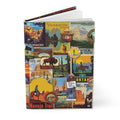
The cover of this journal is not a single WPA poster but a collage — a gathering of vintage park ephemera that places multiple parks, multiple images, and multiple moments in American outdoor history side by side. It is, in this sense, closer to the experience of the parks themselves than any single poster could be: a reminder that the national park system is not one place but many, not one landscape but a continent’s worth of geological and ecological diversity, held together by a single democratic idea.
To carry this journal is to carry a fragment of that idea — the conviction that the wild places of the earth are worth preserving, worth visiting, and worth writing about.

Vintage national parks travel ephemera — posters, stamps, and illustrations from the golden age of American outdoor exploration — on the cover of a hardcover journal. For hikers, road trippers, and anyone who finds solace in wild landscapes.
👉 National Parks Journal — USA Vintage Travel
References
- McKinzie, R.D. (1973). The New Deal for Artists. Princeton University Press.
- Marling, K.A. (1982). Wall-to-Wall America: A Cultural History of Post-Office Murals in the Great Depression. University of Minnesota Press.
- Sellars, R.W. (1997). Preserving Nature in the National Parks: A History. Yale University Press.
- Stegner, W. (1960). Letter to David Pesonen, Wildland Research Center.
- Runte, A. (1979). National Parks: The American Experience. University of Nebraska Press.
- Library of Congress, Prints & Photographs Division. WPA Poster Collection.