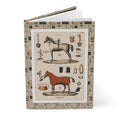
Alp Camille Jeune and the Golden Age of Parisian Saddlery
In the spring of 1890, a visitor to the great equestrian establishments of Paris — the racing stables of Longchamp, the cavalry barracks of the École Militaire, the elegant riding schools of the Bois de Boulogne — would have encountered, in the tack rooms and saddleries of the finest establishments, equipment bearing the mark of one of the most distinguished names in French equestrianism: Alp Camille Jeune, saddlers, established Paris 1826. Founded in the last years of the Restoration and flourishing through the July Monarchy, the Second Empire, and the Third Republic, Alp Camille Jeune had, by 1890, accumulated more than six decades of experience in the production of the finest equestrian equipment in France — saddles, bridles, stirrups, girths, and the full range of horse tack required by the racing world, the cavalry, and the elegant society that made the horse the defining symbol of aristocratic and bourgeois status in 19th-century France.

The Parisian Saddlery Industry
The saddlery industry of 19th-century Paris was one of the most technically sophisticated and artistically refined of the city's luxury trades. Like the great houses of haute couture, the Parisian saddlers combined extraordinary technical skill with an aesthetic sensibility that elevated their products from mere utility objects to works of art — objects whose beauty was inseparable from their function, and whose quality was a direct expression of the values of the civilization that produced them. The finest Parisian saddles were works of precision engineering: the tree — the rigid frame that gave the saddle its shape — was carved from seasoned beechwood and covered with stretched rawhide; the seat was padded with wool and covered with the finest leather, cut and stitched with a precision that required years of apprenticeship to master; the panels were stuffed with wool or felt and shaped to distribute the rider's weight evenly across the horse's back.
The leather itself was the foundation of everything. The great Parisian saddlers sourced their hides from the finest tanneries in France and England — the oak-bark tanned leather of Annonay, the pit-tanned bridle leather of Walsall — and subjected them to months of preparation before they were ready to be cut and stitched. The finishing of the leather — the dyeing, the burnishing, the application of wax and oil — was a craft of extraordinary subtlety, and the warm, deep tones of a well-finished Parisian saddle were as much a mark of quality as the precision of the stitching or the accuracy of the fit.
The 1890 Catalog and the Art of Chromolithography
In 1890, Alp Camille Jeune published a trade catalog documenting their complete range of equestrian equipment in chromolithographic plates of extraordinary precision. The catalog served a dual purpose: as a commercial document, it allowed customers across France and Europe to order equipment by reference to the plate numbers; as a record of the saddlery's range, it documented the full extent of Jeune's production at the peak of the Belle Époque, from the jockey's racing saddle to the cavalry soldier's field equipment.
The chromolithographic technique used to produce the catalog plates was, by 1890, at the height of its development. Invented in the 1830s and refined over the following decades, chromolithography — the printing of images in multiple colors from a series of lithographic stones, each carrying a different color — had become the dominant medium for the reproduction of colored images in the second half of the 19th century, used for everything from fine art reproductions and illustrated books to trade catalogs and advertising posters. The finest chromolithographic work — produced by the great printing houses of Paris, London, and Leipzig — could achieve a fidelity of color and detail that rivaled hand-coloring, and the Jeune catalog plates are among the finest examples of the technique applied to the documentation of luxury craftsmanship.
Plate 102.B — the jockey equipment plate that appears on the front cover of the journal — is a characteristic example of the catalog's illustrative approach: saddles, bridles, stirrups, and girths arranged against a neutral background, each object rendered with extraordinary attention to the textures of leather and the gleam of polished metal, the multi-layer printing technique capturing the warm tones of fine leather, the silver of steel stirrups, and the brass of buckles and fittings with a precision that anticipates modern technical illustration. The military horse tack and cavalry gear of the back cover reveal a different dimension of Jeune's production: the practical, utilitarian equipment of the French cavalry, including the remarkable étui à dynamite — the leather case for carrying explosive charges — and the axe holder that document the full range of the saddlery's military utility applications.
The Horse in Belle Époque Society
The extraordinary refinement of the Parisian saddlery industry in the Belle Époque was inseparable from the central role that the horse played in the society of the period. In 1890, the horse was still the primary means of transport for both people and goods in Paris and throughout France — the automobile was a curiosity, the bicycle a novelty, and the horse-drawn vehicle the universal mode of movement for everything from the elegant carriage of the bourgeoisie to the heavy wagon of the market gardener. The French cavalry — still, in 1890, a central element of the army's order of battle — required enormous quantities of saddlery and horse equipment, and the great saddlery houses of Paris competed for the lucrative military contracts that supplied the cuirassiers, the dragoons, the hussars, and the chasseurs with their equipment.
But it was in the world of racing and elegant equestrianism that the Parisian saddlery industry found its most demanding and most prestigious customers. The racing world of the Belle Époque — centered on the great courses of Longchamp, Chantilly, and Deauville — was one of the most fashionable arenas of French society, and the equipment of the jockey and the racehorse was subject to the same standards of precision and elegance that governed every other aspect of the racing world. The finest jockey saddles — weighing as little as a few hundred grams, constructed with a precision that left no margin for error — were among the most technically demanding products of the Parisian saddlery industry, and their production required the highest levels of skill and experience that the trade could offer.
The Legacy of the Parisian Saddlers
The world that Alp Camille Jeune served — the world of the Belle Époque horse, of the racing stable and the cavalry barracks and the elegant riding school — was transformed beyond recognition by the First World War and the subsequent mechanization of transport and warfare. The great Parisian saddlery houses that had flourished in the 19th century either disappeared or reinvented themselves: some, like Hermès — founded as a saddlery in 1837 and still bearing the horse and carriage on its logo — survived by transforming their equestrian craftsmanship into a broader luxury goods business. Others, like Alp Camille Jeune, left behind only their catalogs and their products as records of a craft tradition of extraordinary refinement.
The 1890 catalog of Alp Camille Jeune is one of the finest of these records: a chromolithographic document of French equestrian craftsmanship at its Belle Époque peak, preserving in its precise plates the textures of leather, the gleam of metal, and the geometry of equestrian engineering that defined the golden age of the Parisian saddlery industry.
If the elegance of the Belle Époque stable inspires you, our Equestrian Journal — Alp Camille Jeune 1890 Parisian Saddlery brings the catalog's chromolithographs to the cover of a hardcover journal.
References
- Alp Camille Jeune. Catalog of Equestrian Equipment. Paris, 1890.
- Dumas, A. Le Grand Dictionnaire de Cuisine. Paris, 1873.
- Roche, D. La Culture équestre de l'Occident, XVIe–XIXe siècle. Fayard, 2008–2015.
- Twyman, M. A History of Chromolithography: Printed Colour for All. British Library, 2013.
- Picard, R. Le Cheval dans la société française au XIXe siècle. Éditions du CTHS, 2002.