The Weaver and the Prince: Alexander Wilson, Charles Bonaparte, and the Owls of North America
Share
In 1794, a young Scottish weaver named Alexander Wilson arrived in America with almost nothing. He had left Scotland under a cloud — convicted of writing a satirical poem about a local mill owner, he had served time in prison and been forced to burn his own work publicly. He was twenty-eight years old, he had no money, and he had no particular plan.
What he had, it turned out, was an extraordinary eye.
The Weaver Who Became a Naturalist
Wilson settled in Pennsylvania and began to teach school, spending his free hours walking the forests and fields of the young republic, watching birds. He had no formal scientific training. He taught himself Latin to read the existing ornithological literature. He taught himself to draw. He taught himself to engrave. And over the next two decades, he produced American Ornithology (1808–1814) — nine volumes documenting over 260 species of North American birds, with hand-coloured engravings of extraordinary precision and beauty.
It was the first comprehensive scientific study of North American birds. It predated John James Audubon’s more celebrated Birds of America by two decades. And it established the scientific and artistic standards that would define American ornithological illustration for a generation.
Wilson died in 1813, before the final volumes were complete. He was forty-seven years old. He had spent the last years of his life travelling thousands of miles on foot and horseback through the American wilderness, documenting species that no European scientist had ever described. He died, by most accounts, of exhaustion.
The Prince Who Continued the Work
Charles Lucian Bonaparte (1803–1857) was, by birth, about as far from Alexander Wilson as it was possible to be. He was the son of Lucien Bonaparte, Napoleon’s brother, and a prince of the French Empire. He had grown up in the courts of Europe, educated by private tutors, surrounded by the apparatus of imperial power.
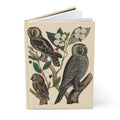
He was also, from an early age, a serious naturalist — and when he came to America in the 1820s, he discovered Wilson’s American Ornithology and recognised it immediately as a foundational work that deserved to be continued. His own continuation, published in the Edinburgh Journal of Natural History (1835), documented additional North American species with the same meticulous hand-coloured engraving technique that Wilson had established — including Plate XIII, which brought together four owl species that Wilson had not fully documented: the Barred Owl, the Burrowing Owl, the Northern Hawk-Owl, and the Barn Owl.
Six Owls, Two Centuries
Together, Wilson and Bonaparte documented six North American owl species across two publications separated by nearly three decades: the Northern Hawk Owl, the Great Gray Owl, and the Little Owl from Wilson’s 1808 plates; the Barred Owl, the Burrowing Owl, and the Barn Owl from Bonaparte’s 1835 continuation. It is a remarkable collaboration across time — a Scottish weaver and a French prince, united by their devotion to the birds of the New World.
The owls themselves are extraordinary subjects. The Great Gray Owl, with its enormous concentric facial disc and its ability to locate prey beneath two feet of snow by sound alone. The Burrowing Owl, which nests underground in the burrows of prairie dogs and ground squirrels. The Barn Owl, whose heart-shaped face and silent flight have made it one of the most recognisable birds in the world. Wilson and Bonaparte gave them their first great scientific portraits — and in doing so, gave us a way of seeing the American wilderness that no subsequent generation has quite surpassed.