The Atlas and the Crystal: Scientific Illustration in Central Europe and the Legacy of Alexander Bernard’s Atlas Minerálů
In the late 19th and early 20th centuries, Central Europe was the world capital of scientific illustration. The great publishing houses of Prague, Vienna, Leipzig, and Frankfurt were producing atlases, encyclopedias, and educational manuals whose illustrated plates set the standard for scientific documentation across the continent. The tradition drew on centuries of craft — the engravers and lithographers of the German-speaking world had developed techniques of extraordinary precision — and it was animated by a pedagogical conviction that scientific knowledge should be made visible, that the student who could see a mineral’s crystalline form, a plant’s anatomical structure, or a bird’s plumage in accurate colour would understand it in a way that no verbal description could achieve.
Alexander Josef Bernard’s 1907 Atlas minerálů is one of the finest products of this tradition.
The Central European Scientific Illustration Tradition
The tradition of scientific illustration in Central Europe had deep roots. The great herbals of the 16th century — Leonhart Fuchs’s De Historia Stirpium (1542), Rembert Dodoens’s Cruydeboeck (1554) — established the principle that botanical knowledge required visual documentation, and the woodcut illustrations of those early works set a standard of accuracy and beauty that subsequent generations of illustrators worked to surpass.
By the 19th century, the woodcut had given way to the copperplate engraving and then to lithography — a technique invented in 1796 by Alois Senefelder in Munich that allowed illustrators to draw directly on stone and reproduce their work with a fidelity and tonal range that engraving could not match. Lithography transformed scientific illustration. The subtle gradations of colour that a mineral’s lustre required, the delicate texture of a butterfly’s wing, the precise rendering of a crystal’s geometric form — all became achievable in ways that earlier techniques had not permitted.
The great scientific publishers of Central Europe — I. L. Kober in Prague, Brockhaus in Leipzig, Bibliographisches Institut in Hildburghausen and later Leipzig — invested heavily in lithographic illustration, employing teams of artists and colorists whose work appeared in encyclopedias, atlases, and educational manuals distributed across the continent. The plates produced by these publishers were not merely illustrations but works of art in their own right — objects of beauty that happened also to be instruments of scientific education.
Alexander Josef Bernard and the Atlas Minerálů
Alexander Josef Bernard (1859–1912) was a Czech naturalist and pedagogue whose career exemplified the Central European tradition of scientific illustration at its finest. Born in Bohemia — a region with deep roots in mining and mineralogy, where the silver mines of Kutná Hora and the mineral deposits of the Krušné hory mountains had been worked since the medieval period — Bernard brought to his work both the scientific rigour of the trained naturalist and the pedagogical conviction of the educator.
The Atlas minerálů, published by I. L. Kober in Prague in 1907, was the culmination of Bernard’s career as a scientific illustrator. Its 26 coloured plates documented 396 mineral species with a lithographic precision that had no precedent in Czech scientific publishing. Each plate was designed as a pedagogical instrument — the minerals arranged to illustrate their crystalline forms, habits, and characteristic features, labeled with the scientific precision that students and collectors needed to identify specimens in the field.
The atlas’s authority was recognized immediately. Its plates were reproduced in Meyers grosses Konversations-Lexikon — the great German encyclopedia that was the standard reference work of the educated European household — a recognition that placed Bernard’s work alongside the finest scientific illustration of the era. The Atlas minerálů became the standard visual reference for mineralogy education across Central Europe, used in schools, universities, and natural history museums from Prague to Vienna to Kraków.
The Minerals of Plate XXIV
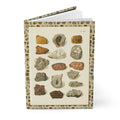
The minerals documented in Plate XXIV of the Atlas minerálů are among the most important ore minerals of the Central European mining tradition.
Galena — lead sulfide, PbS — is one of the oldest known minerals, worked for its lead content since antiquity and for its silver content since the medieval period. The silver mines of Kutná Hora in Bohemia, which made the Kingdom of Bohemia one of the wealthiest states in medieval Europe, were galena deposits. Its characteristic cubic crystals and brilliant metallic lustre make it one of the most visually striking of the ore minerals.
Sphalerite — zinc sulfide, ZnS — is the primary ore of zinc, a metal whose importance to industrial civilization has only grown since Bernard’s time. Its variable colour — from pale yellow to deep brown to black, depending on its iron content — and its resinous to adamantine lustre give it a visual complexity that Bernard’s lithographers captured with remarkable fidelity.
Molybdenite — molybdenum disulfide, MoS₂ — is the primary ore of molybdenum, a metal used in high-strength steel alloys. Its soft, platy crystals and metallic lustre give it a visual similarity to graphite that Bernard’s plate documents with characteristic precision.
Pyrite — iron sulfide, FeS₂ — is perhaps the most famous of the ore minerals, known since antiquity as “fool’s gold” for its golden colour and metallic lustre. Its perfect cubic crystals are among the most geometrically precise forms in the mineral kingdom, and Bernard’s lithographers rendered them with the mathematical exactitude they deserved.
The Legacy of the Atlas
The Atlas minerálů belongs to a tradition of scientific illustration that the digital age has not replaced but has made newly visible. The plates of Bernard’s atlas — like the botanical illustrations of the florilegia, the anatomical drawings of Vesalius, the geological maps of William Smith — are now recognized not merely as scientific documents but as works of art: objects of beauty that encode the scientific knowledge of their era in visual form.
What Bernard achieved in the Atlas minerálů was the union of scientific accuracy and aesthetic beauty that the Central European illustration tradition at its best always sought. His minerals are not merely documented — they are celebrated, presented with the care and attention that their crystalline beauty deserves.

Our Alexander Bernard Mineralogy Journal carries Plates XXIV and XVI from the 1907 Atlas minerálů — galena, pyrite, sphalerite, and quartz documented by Bernard with the lithographic precision of Central Europe’s greatest tradition of scientific illustration.
References
- Bernard, Alexander Josef. Atlas minerálů. I. L. Kober, Prague, 1907.
- Meyers grosses Konversations-Lexikon. Bibliographisches Institut, Leipzig, 1905–1909.
- Agricola, Georgius. De Re Metallica. Basel, 1556.
- Burke, John G. Origins of the Science of Crystals. University of California Press, 1966.