Adolphe Millot and the Art of Entomological Illustration in the Nouveau Larousse illustré
The insect world is, by any measure, the dominant form of animal life on Earth. There are more species of beetle alone than there are species of all vertebrates combined. The diversity of form, colour, and behaviour that the class Insecta encompasses — from the iridescent wing cases of tropical beetles to the geometric precision of a dragonfly’s wings, from the mimicry of stick insects to the social architecture of ant colonies — has fascinated naturalists since the beginnings of systematic natural history. It has also, for the same length of time, presented illustrators with one of their most demanding and rewarding subjects.
Adolphe Millot (1857–1921) was one of the most important scientific illustrators of the late nineteenth and early twentieth centuries, and his work for the Nouveau Larousse illustré: dictionnaire universel encyclopédique — published in Paris between approximately 1897 and 1904 — represents the high point of his achievement. The Nouveau Larousse illustré was one of the great encyclopedic publishing projects of the Third Republic, a comprehensive dictionary of the French language and of human knowledge that ran to eight volumes and was illustrated throughout with plates of exceptional quality. Millot was responsible for the natural history plates, and his contributions — covering botany, zoology, entomology, and marine biology — are among the finest examples of French scientific illustration of the era.
The Tradition of French Entomological Illustration
Millot’s entomological plates stood within a long and distinguished tradition of French natural history illustration that stretched back to the seventeenth century. The Mémoires pour servir à l’histoire des insectes of René-Antoine Ferchault de Réaumur, published between 1734 and 1742, had established the standard for detailed entomological observation and illustration in France; the work of Pierre André Latreille, the greatest entomologist of the Napoleonic era, had systematised the classification of insects on the basis of direct observation; and the plates of the Histoire naturelle des insectes by Georges Cuvier and his collaborators had demonstrated what chromolithography could achieve in the service of entomological science.
By the time Millot began work on the Nouveau Larousse illustré in the 1890s, this tradition had been enriched by decades of development in printing technology and by the expansion of French natural history collections — the Muséum National d’Histoire Naturelle in Paris held, and continues to hold, one of the largest entomological collections in the world — that gave illustrators access to specimens of extraordinary diversity and quality. Millot’s insect plates reflect this richness: they show not one or two representative species but dozens, arranged on the page with the compositional skill of a painter and the taxonomic precision of a scientist.
The Insectes Plates
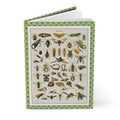
The two Insectes plates that appear on the covers of the journal are characteristic of Millot’s method and achievement. Each plate presents a selection of insect species from across the taxonomic range — beetles, butterflies, dragonflies, moths, flies, and others — rendered with careful attention to the details that distinguish one species from another: the pattern of wing venation, the structure of the antennae, the segmentation of the abdomen, the form of the legs and mouthparts. The specimens are shown from multiple angles where necessary, with details enlarged to show features that would be invisible at natural size.
What distinguishes Millot’s plates from purely scientific illustration is the quality of his colour work. The iridescent blues and greens of beetle wing cases, the precise geometry of butterfly wing patterns, the translucent delicacy of dragonfly wings — all are rendered with a fidelity to the living specimen that reflects both direct observation and a deep understanding of the printing techniques available to him. Chromolithography, at its best, could reproduce the full range of natural colour with a subtlety that earlier printing methods could not achieve, and Millot’s plates exploit this capability to the full.
The Larousse and the Democratisation of Knowledge
The Nouveau Larousse illustré was, like all the great Larousse encyclopedic projects, conceived as an instrument of popular education — a work that would make the accumulated knowledge of the sciences and the humanities available to the widest possible French-speaking audience. Pierre Larousse, who had founded the publishing house in 1852, had always understood the encyclopedia as a democratic project: knowledge was not the property of the learned, but a common inheritance that belonged to everyone who could read. The illustrations — and Millot’s natural history plates in particular — were central to this project, making visible the diversity of the natural world to readers who might never have access to a natural history museum or a scientific library.
This democratic ambition gives Millot’s plates a significance that goes beyond their considerable aesthetic merit. They were not produced for specialists, but for the general reader — for the schoolteacher in a provincial town, the curious student, the amateur naturalist who kept a collection of pinned specimens in a wooden box and wanted to know what they had found. In this sense, they belong to the same tradition as the botanical plates of El Tesoro de la Juventud or the astronomical diagrams of John Emslie: the tradition of making knowledge beautiful, and beauty instructive.

If Adolphe Millot’s entomological plates and the golden age of French scientific illustration resonate with you, the Entomology Journal brings his Insectes plates from the Nouveau Larousse illustré to a hardcover journal — 150 lined pages, ready for field notes, specimen sketches, or whatever the natural world inspires.
References
- Larousse, P. (ed.) Nouveau Larousse illustré: dictionnaire universel encyclopédique. Librairie Larousse, Paris, 1897–1904.
- Réaumur, R.A.F. de. Mémoires pour servir à l’histoire des insectes. Paris, 1734–1742.
- Farber, P.L. Finding Order in Nature: The Naturalist Tradition from Linnaeus to E.O. Wilson. Johns Hopkins University Press, Baltimore, 2000.
- Lack, H.W. Garden Eden: Masterpieces of Botanical Illustration. Taschen, Cologne, 2008.
- Lightman, B. Victorian Popularizers of Science: Designing Nature for New Audiences. University of Chicago Press, 2007.